
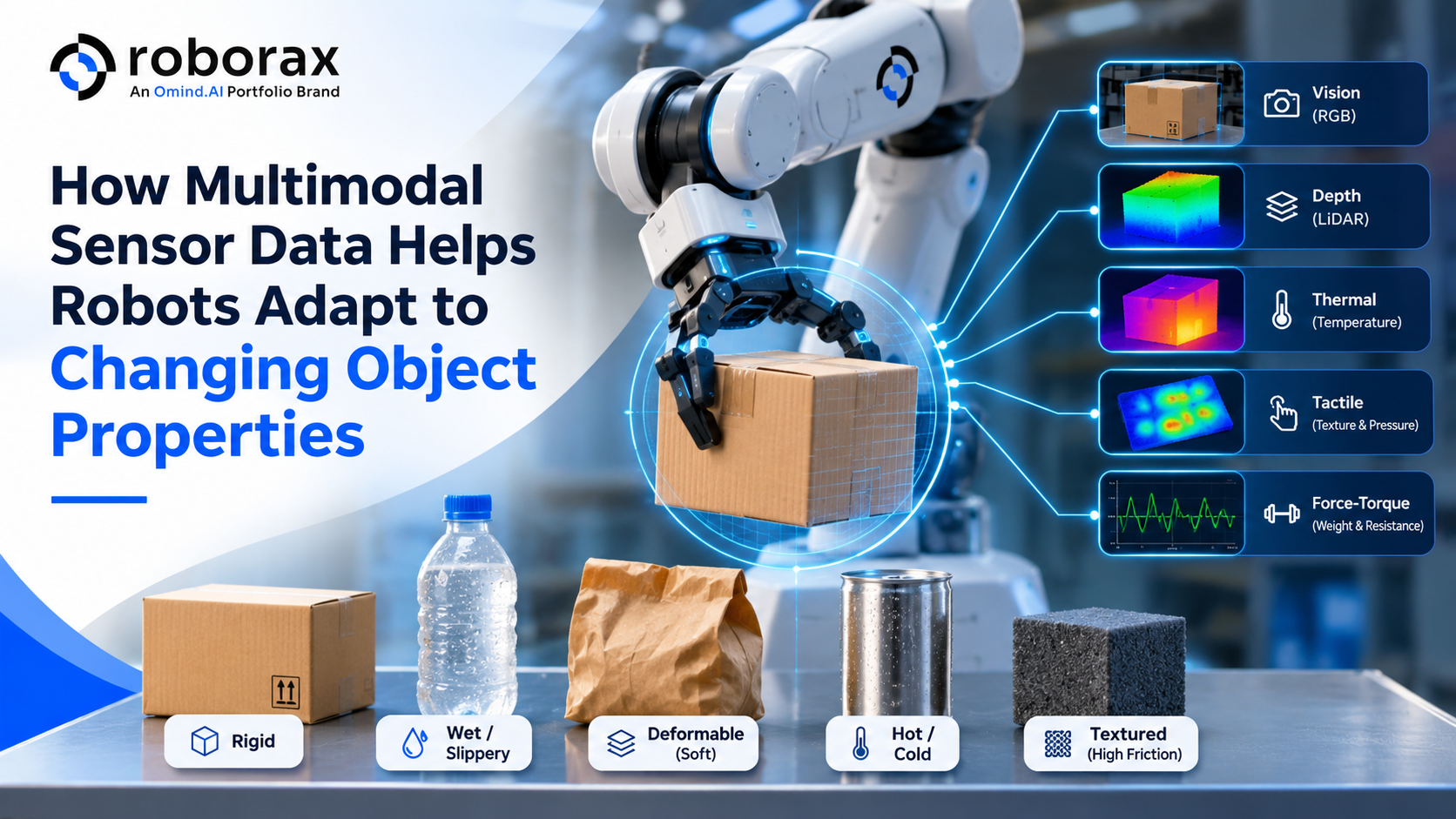
How Multimodal Sensor Data Helps Robots Adapt to Changing Object Properties

Robots operating in dynamic environments must do more than identify objects and execute predefined movements. They need to recognize when an object's properties change and adjust their actions accordingly. A plastic container may become slippery when wet, a cardboard box may deform under pressure, and a metal component may become heavier or hotter during industrial operations. These variations can significantly affect how robots perceive, handle, and manipulate objects.
Traditional robotic systems often depend on individual sensors or predefined object characteristics. However, these approaches can struggle when real-world conditions differ from training environments. Multimodal sensor data addresses this limitation by combining information from cameras, LiDAR, force-torque sensors, tactile sensors, and other measurement systems. Through Multimodal Sensor Capture for Robotics, developers can build more adaptable robotic systems capable of responding to changing physical conditions.
1. Understanding Changing Object Properties in Robotics
Object properties influence how robots interact with their surroundings. These properties include shape, size, weight, texture, temperature, rigidity, friction, and surface condition. Unlike static datasets, real-world environments introduce continuous variations that require robots to reassess their understanding of objects.
For example, a robot trained to pick up a rigid plastic bottle may encounter a partially filled bottle that changes its weight distribution. Similarly, a robotic arm handling a fabric material must account for deformation, folding, and unpredictable movement.
Such variations create challenges for perception, grasp planning, force control, and manipulation. A robot that relies exclusively on visual information may identify an object's shape correctly but fail to estimate its actual weight or surface friction.
Combining multiple sensor inputs allows robotic systems to develop a more comprehensive understanding of object characteristics and respond more effectively to environmental changes.
2. Combining Multiple Sensors for Better Object Understanding
Different sensors capture different aspects of an object's physical properties. Combining these signals helps robots overcome the limitations of individual sensing technologies.
Key sensor modalities include:
-
RGB and depth cameras: Capture visual appearance, dimensions, spatial relationships, and surface geometry.
-
LiDAR sensors: Provide accurate three-dimensional measurements of object positions, shapes, and surrounding environments.
-
Force-torque sensors: Measure applied forces and rotational forces during object interaction, helping robots identify resistance and weight-related changes.
-
Tactile sensors: Detect contact, pressure distribution, surface texture, and slippage during manipulation.
-
Thermal sensors: Identify temperature variations that may influence material handling and operational safety.
-
IMUs: Capture acceleration and rotational movement, supporting motion estimation and object interaction analysis.
When these inputs are synchronized and integrated, robots can compare visual predictions with physical feedback. For instance, a camera may identify a glass container, while tactile and force sensors reveal whether the container is slipping or requires a lighter grip.
This combination improves situational awareness and enables more reliable robotic decision-making.
3. Detecting Changes in Weight, Texture, and Surface Conditions
One of the most important applications of multimodal sensing is detecting physical changes that affect object manipulation.
Weight and mass distribution: Force-torque sensors help robots recognize differences between expected and actual object loads. If an object is heavier than anticipated, the system can modify lifting force, acceleration, and movement trajectories.
Texture and friction: Tactile sensors provide information about surface contact and friction. A robot handling a smooth metal component can adjust its grip when oil or moisture reduces surface traction.
Shape and deformation: Depth cameras and tactile feedback help identify changes in object geometry. This is particularly useful when handling flexible packaging, fabric, foam, and deformable industrial materials.
Temperature and material conditions: Thermal sensing can identify hot surfaces or temperature-related variations that influence handling decisions.
These capabilities help robots move beyond fixed object classifications and respond to the actual physical condition of an object during operation.
4. The Role of Robotic Training Data in Adaptive Manipulation
Sensor technology alone cannot make a robot adaptive. Machine learning models require diverse, accurately synchronized, and well-structured robotic training data to understand how different object properties influence physical interactions.
Training datasets should capture variations in object materials, dimensions, weight, surface conditions, environmental lighting, and contact behavior. They should also include examples of successful and unsuccessful manipulation attempts.
For instance, a robotic grasping dataset could include multiple interactions with the same object under different conditions:
-
Picking up a dry plastic container and a wet plastic container.
-
Grasping rigid and partially compressed cardboard boxes.
-
Handling metal objects with different surface temperatures.
-
Manipulating lightweight and heavy objects with similar visual appearances.
-
Detecting and recovering from unexpected object slippage.
Each interaction should ideally include synchronized camera footage, force measurements, tactile signals, robot joint positions, and relevant environmental information.
This enables machine learning models to understand relationships between sensory observations and physical outcomes. Rather than memorizing object categories, robots can learn how to adjust their actions based on observed conditions.
5. How Multimodal Sensor Capture Improves Real-Time Adaptation
Multimodal Sensor Capture for Robotics creates the foundation for adaptive robotic behavior by collecting complementary sensor information throughout an interaction.
A typical workflow involves four stages:
Stage 1: Sensor acquisition and synchronization
Multiple sensors capture information about the object and its surroundings. Accurate timestamps ensure that visual observations, force measurements, and tactile signals correspond to the same interaction events.
Stage 2: Sensor fusion and feature extraction
The collected signals are processed to identify relevant characteristics, including object geometry, contact pressure, movement, and resistance.
Stage 3: Adaptive decision-making
Machine learning models evaluate the combined information and determine whether the current manipulation strategy needs modification.
Stage 4: Feedback-based action adjustment
The robot changes its grip strength, movement speed, trajectory, or contact position based on updated sensory feedback.
For example, when a robot detects that a box is deforming during lifting, it can reduce gripping pressure, reposition its end effector, or modify its lifting trajectory. This feedback-driven process improves handling precision and reduces unnecessary manipulation errors.
6. Applications Across Industrial and Real-World Robotics
Adaptive object handling has practical applications across several industries.
-
Warehouse automation: Robots can handle packages with varying weights, dimensions, and structural integrity without relying entirely on predefined object specifications.
-
Manufacturing: Robotic arms can adjust gripping force when handling components with different surface finishes, temperatures, or material properties.
-
Food processing: Robots can manipulate delicate products with varying firmness, shape, and moisture levels while minimizing physical damage.
-
Healthcare robotics: Assistive and service robots can adapt their interaction forces when handling objects with different physical characteristics.
-
Agriculture: Harvesting robots can respond to variations in fruit size, firmness, and surface conditions to improve handling accuracy.
These applications demonstrate why adaptive perception and manipulation are becoming essential capabilities for next-generation robotic systems.
7. Building Reliable Multimodal Datasets for Adaptive Robots
Developing adaptive robots requires more than collecting large volumes of sensor information. Dataset quality, synchronization, annotation consistency, and environmental diversity directly influence model performance.
Robotics teams should prioritize synchronized multimodal recordings, accurate sensor calibration, representative object variations, and detailed interaction labels. They should also include edge cases such as unexpected slippage, partial object deformation, sensor noise, and failed grasp attempts.
Robust quality assurance is equally important. Missing sensor readings, timestamp inconsistencies, and incorrect annotations can introduce errors into model training and evaluation.
Roborax supports robotics and Physical AI development through multimodal sensor capture, robotic data collection, and structured data preparation workflows. By capturing diverse physical interactions and organizing high-quality training datasets, Roborax helps robotics teams develop models that better understand real-world object behavior.
Conclusion
Robots must continuously adapt to changing object properties if they are expected to operate reliably beyond controlled environments. Weight variations, surface friction, deformation, and temperature changes can all influence manipulation outcomes.
Integrating visual, tactile, force, depth, and thermal information gives robots a more complete understanding of physical interactions. Supported by diverse robotic training data and reliable sensor synchronization, these capabilities enable more responsive perception, improved grasping, and intelligent manipulation.
As Physical AI advances, Multimodal Sensor Capture for Robotics will remain an important foundation for developing robots that can recognize changing conditions, learn from physical feedback, and perform complex tasks with greater adaptability.