
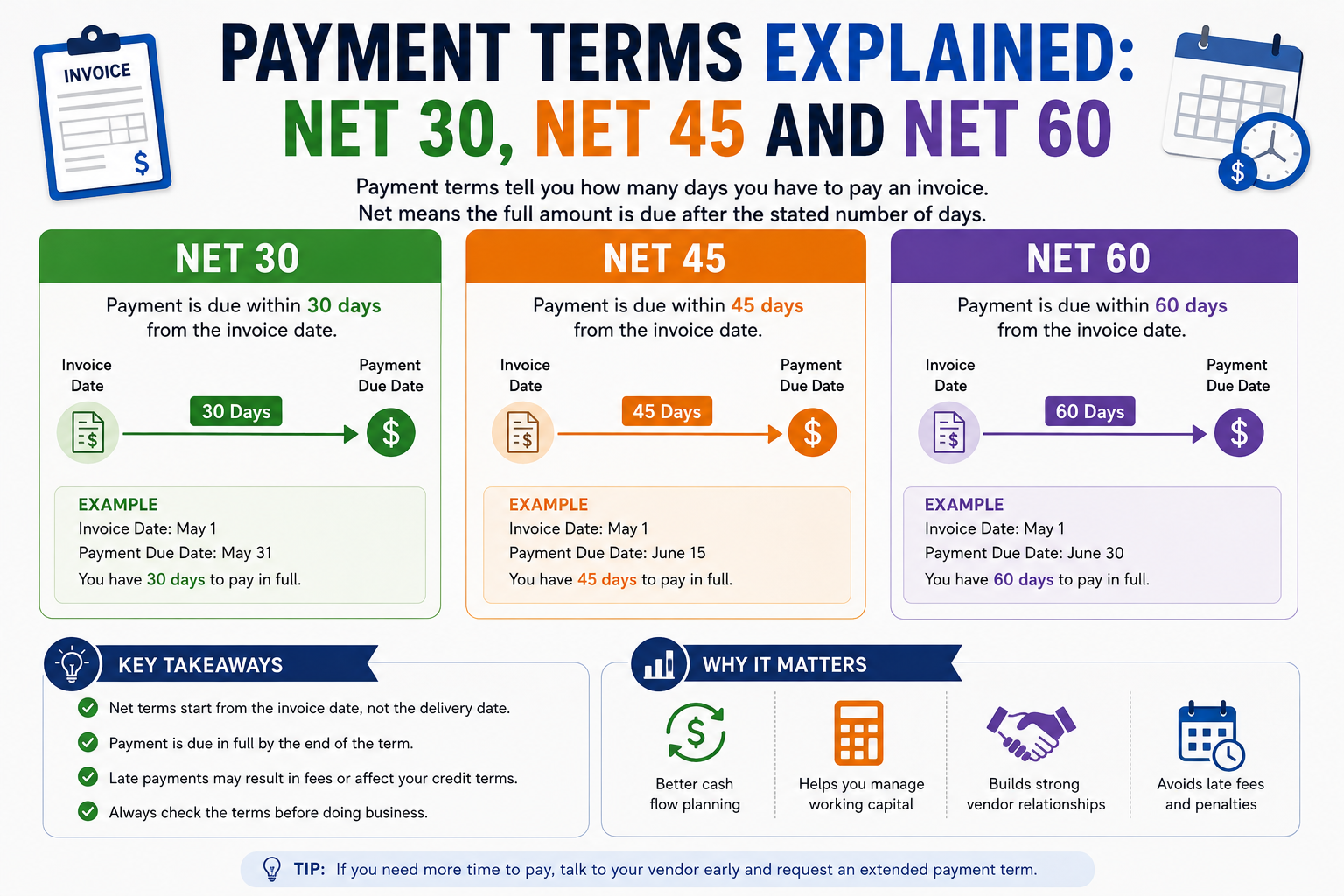

Payment terms tell you when an invoice must be paid. "Net 30" means the money is due 30 days after the invoice date, and "Net 60" means 60 days. It is also useful to know how long customers really take. Say four customers paid in 28, 35, 41 and 30 days. The total is 134 days, and an average finder gives 134 ÷ 4 = 33.5 days. That tells you if your customers pay on time.
This article is general information, not legal or financial advice. Always check the exact wording of your own invoice or contract.
What does "Net" mean?
"Net" means the full invoice amount is due after the stated number of days. The number is the days you have to pay. So:
-
Net 30: pay within 30 days
-
Net 45: pay within 45 days
-
Net 60: pay within 60 days
The number always starts from a date, and that date is often the invoice date. Some invoices count from the day the goods arrive, or the day the invoice is received. The wording on the invoice should tell you which one.
An example with real dates
Say an invoice is dated Tuesday 10 March 2026. If the first day counted is the day after the invoice date, the due dates look like this:
|
Terms |
Due date |
|
Net 30 |
Thursday 9 April 2026 |
|
Net 45 |
Friday 24 April 2026 |
|
Net 60 |
Saturday 9 May 2026 |
The Net 60 date falls on a Saturday. Many businesses will not process payments at the weekend, so the money may arrive on the next working day, or you may need to pay on the Friday before. Ask your supplier or customer which rule they use.
"Net 30 EOM"
You may see "EOM" after the terms. It means "end of month". With "Net 30 EOM", the 30 days start counting from the end of the month in which the invoice was dated.
For the invoice dated 10 March, the end of the month is 31 March. Adding 30 days gives 30 April. That is 21 days later than plain Net 30. This is a big difference for cash flow, so read the small letters.
Early payment discounts
Some terms offer a discount for paying early. A common style is written as "2/10 Net 30". It means:
-
take 2% off if you pay within 10 days
-
otherwise pay the full amount within 30 days
On a $1,000 invoice dated 10 March, paying by Friday 20 March would save 2% of $1,000, which is $20, so you pay $980. After that, you pay the full $1,000 by 9 April.
Think about whether the discount is worth it. You get $20 for paying 20 days sooner. If your cash is tight, it may not be. If you have the money, it can be a good deal.
Counting the days yourself
You can count the days by hand. Start at the invoice date, add the days, and take care when you cross a month. For a simple list of tools to check dates and other everyday sums, you can visit this free calculator site, which collects calculators for maths, finance and daily tasks.
For the business that sends invoices
Long terms mean you wait for your money. A $5,000 invoice on Net 60 means you do not see that money for two months. Here are some ways to make it easier:
-
Offer shorter terms, such as Net 14 or Net 30, for new customers.
-
Give a small discount for early payment.
-
Send the invoice the same day the work is done.
-
Send a polite reminder a few days before the due date.
For the business that pays invoices
Late payments can bring fees and hurt the relationship. Put the due date in your calendar the moment an invoice arrives. If cash is short, ask for more time before the due date, not after.
It also helps to see who you owe and when. A simple list sorted by due date shows what needs paying this week.
Common mistakes
-
Counting from the wrong date.
-
Forgetting that months have 28 to 31 days.
-
Missing the weekend problem.
-
Mixing up "Net 30" and "Net 30 EOM".
-
Paying early without checking if there is a discount.
A short checklist
-
Find the terms on the invoice.
-
Find the date the clock starts.
-
Add the days, taking care with month ends.
-
Check whether the due date falls on a weekend.
-
Put the date in your calendar.
When you are not sure about the count, a day counter will show the number of days between the invoice date and your due date, so you can compare it with the terms.
Final thoughts
Net 30, Net 45 and Net 60 are simple ideas: the invoice is due that many days after the start date. The details are what matter, such as the start date, weekends and month-end rules. Count carefully, keep a calendar, and check the wording before you pay or send an invoice.


