
Electronic Component Obsolescence in 2026: How OEMs Can Protect Long-Term Product Availability

Introduction
Electronic component obsolescence has become an important business risk for original equipment manufacturers (OEMs), industrial automation companies, and manufacturers of long-life electronic products. A product may remain technically reliable and commercially valuable for many years, yet a single discontinued microcontroller, memory device, display controller, or power-management component can threaten its continued production.
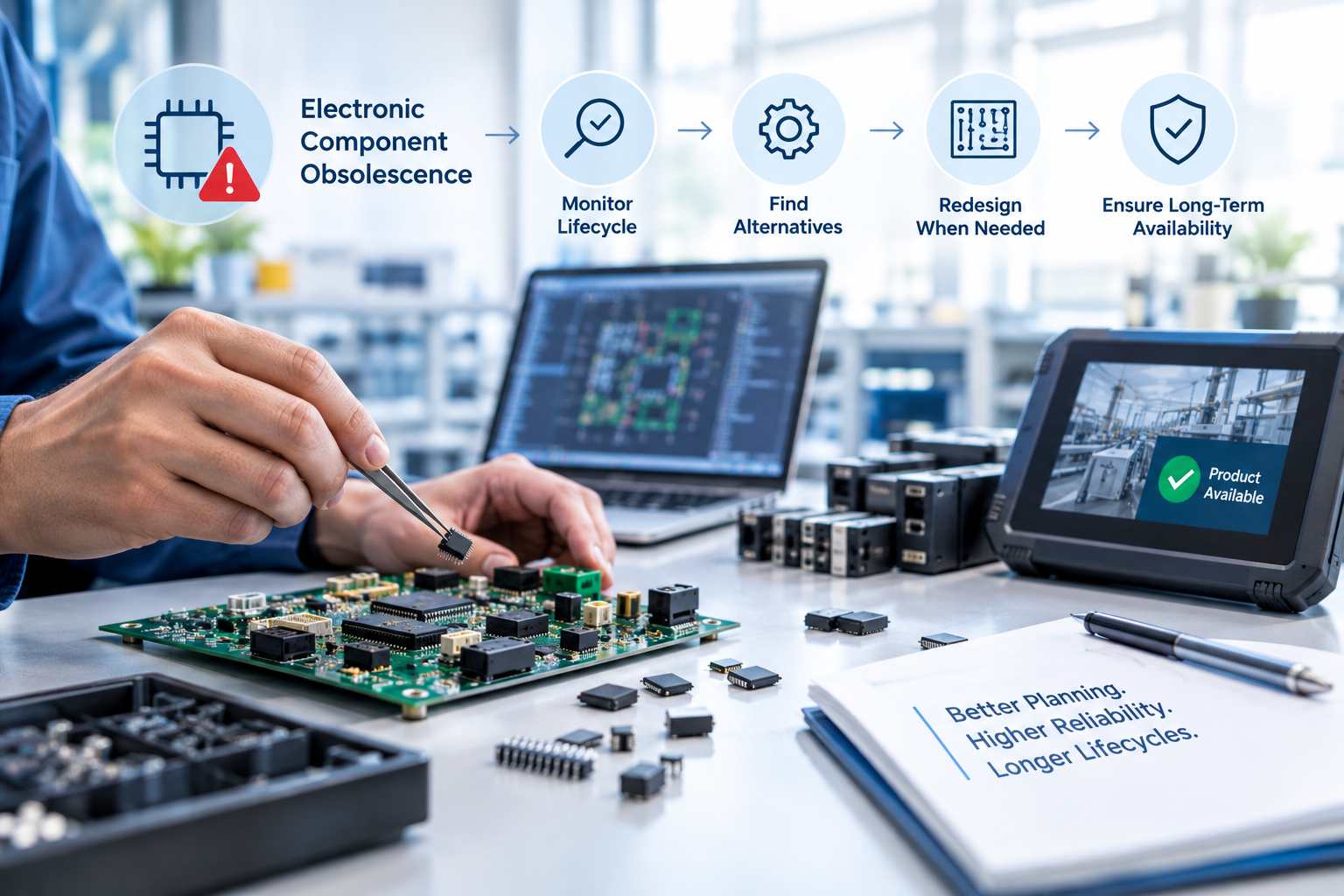
In 2026, managing this risk requires more than finding a replacement part after receiving an end-of-life notice. Manufacturers need a proactive strategy that combines component lifecycle monitoring, supply chain planning, hardware engineering, firmware compatibility, and product redesign where necessary.
A July 2026 report from PMMI, the Association for Packaging and Processing Technologies, found that 52% of surveyed end users reported an increase in obsolescence events over the preceding five years. The report also found that 89% of surveyed OEMs had created conversion kits to replace obsolete components with non-obsolete alternatives. These findings highlight the practical importance of planning for component changes before they interrupt production.
For OEMs supporting industrial tablets, control systems, embedded devices, and specialised electronic equipment, the key question is no longer simply whether a component is available today. It is whether the product can remain available, maintainable, and commercially viable throughout its intended service life.
What Is Electronic Component Obsolescence?
Electronic component obsolescence occurs when a component becomes unavailable, is discontinued by its manufacturer, or can no longer be obtained in a form suitable for the original application.
Manufacturers commonly communicate product lifecycle changes through Product Change Notifications (PCNs), Product Discontinuance Notices (PDNs), and end-of-life (EOL) announcements. These notifications can provide information about discontinuation dates, last-time-buy opportunities, final shipment dates, and possible replacement products.
However, component obsolescence does not always mean that a part has completely disappeared from the market. A component may still be available through remaining inventory or authorised distributors, but its long-term supply may no longer be guaranteed.
This distinction matters for industrial products that are expected to remain in production or service for many years. A component that is readily available today may still present a significant lifecycle risk if there is no qualified alternative.
Why Component Obsolescence Matters More in 2026
1. Electronic products have different lifecycle requirements
Many industrial and medical products have longer lifecycles than the semiconductor components used to build them.
An industrial controller or tablet may need to remain available for a decade or longer, while its processor, memory, display interface, or communication module follows a different commercial lifecycle.
This creates a mismatch between product availability and component availability. Even when the overall product continues to meet customer requirements, a single discontinued component can force an engineering review.
2. Supply chain risks can emerge before a component reaches EOL
A formal discontinuation notice is not the only warning sign. Longer lead times, changing minimum order quantities, limited supplier commitments, repeated price increases, and reduced availability can indicate emerging supply risks.
In June 2026, electronics distributor Avnet highlighted how demand from AI infrastructure and semiconductor market cycles can affect component sourcing and make lifecycle planning and second-source strategies important design considerations.
For OEMs, the practical lesson is to monitor critical components throughout the product lifecycle instead of relying on purchasing teams to identify problems only when an order cannot be fulfilled.
3. Obsolescence can affect the entire product
Replacing one electronic component may require changes to more than the bill of materials.
A replacement microcontroller, for example, may have a different pinout, peripheral set, memory capacity, operating voltage, or software-development environment. The change can affect the PCB layout, firmware, communication interfaces, electrical performance, and testing requirements.
Consequently, component obsolescence can lead to redesign costs, delayed production, additional validation work, and changes to customer delivery commitments.
Which Electronic Components Should OEMs Monitor First?
Not every component carries the same level of risk. OEMs should prioritise parts according to their technical importance, sourcing constraints, and the consequences of losing availability.
Microcontrollers and processors: These components can be difficult to replace because they influence system architecture, firmware, interfaces, and performance.
Memory devices: Flash memory, SRAM, DRAM, and specialised storage components may require compatibility checks, software changes, or PCB modifications when alternatives are introduced.
Power-management components: Regulators, power controllers, and power-management ICs can affect voltage stability, thermal performance, and the operation of the entire system.
Display and interface components: Industrial displays, touch controllers, interface ICs, and supporting components can create redesign challenges when mechanical dimensions or electrical interfaces change.
Communication components: Ethernet, wireless, serial communication, and other interface devices may require hardware and firmware modifications when an alternative is selected.
Custom or single-source components: Parts with limited supplier alternatives deserve particular attention because replacement options may be limited or require extensive engineering work.
A structured component risk assessment helps OEMs identify which parts need immediate action and which can be monitored through routine lifecycle reviews.
How OEMs Can Protect Long-Term Product Availability
1. Conduct a component lifecycle assessment
Start with the current bill of materials (BOM) for each product or product family. Review manufacturer lifecycle information, sourcing options, lead times, supplier concentration, and the availability of potential alternatives.
Create a component risk register that records:
- Manufacturer and exact part number
- Current lifecycle status
- Number of qualified suppliers
- Expected product support requirements
- Availability of potential replacement components
- Engineering effort required for a replacement
- Business impact if the component becomes unavailable
Prioritise components that could stop production or require extensive redesign if they were discontinued.
2. Establish proactive EOL and PCN monitoring
Do not wait for a purchasing problem before investigating component availability.
OEMs should establish a process for receiving and reviewing manufacturer lifecycle notices, assigning responsibility for evaluating them, and communicating important changes to engineering, procurement, production, and product management teams.
For critical components, it is useful to document the expected response to an EOL notice, including technical assessment, alternative sourcing, redesign feasibility, and inventory planning.
Early notification gives engineering teams more time to evaluate options before a last-time-buy deadline or production interruption.
3. Evaluate replacement components before making purchasing decisions
A replacement part should not be selected based on price or a similar datasheet alone.
Check the electrical characteristics, package, pinout, timing, interfaces, operating temperature, firmware requirements, and relevant compliance considerations.
A potential replacement may fall into one of three broad categories:
- Drop-in replacement: Compatible with the existing design, subject to the required verification.
- Functionally similar alternative: Performs a comparable role but requires hardware, firmware, or validation changes.
- Redesign-dependent alternative: Requires a more substantial change to the circuit, architecture, mechanical arrangement, or software.
Manufacturer recommendations should be treated as starting points, not automatic proof of compatibility. The OEM remains responsible for qualifying the replacement for its intended application.
4. Decide between a last-time buy and a redesign
When a component reaches EOL, OEMs often need to decide whether to purchase additional inventory or invest in redesigning the product.
A last-time buy can be appropriate when demand is predictable, the component is available through a reliable channel, and the remaining product lifecycle is clearly understood. However, it introduces risks related to inventory costs, storage, shelf life, cash flow, and demand forecasting.
A redesign may be more suitable when the product has a long remaining lifecycle, the component is difficult to source, or the cost of maintaining the old design is becoming unsustainable.
Before making a decision, compare the total cost of each option. Include component purchasing, inventory management, engineering hours, prototype development, testing, requalification, and potential production downtime.
The cheapest immediate option is not necessarily the most economical over the complete product lifecycle.
5. Redesign hardware and firmware with long-term support in mind
If a replacement component is not directly compatible, the redesign should address the wider product architecture.
Depending on the application, this may involve modifying the PCB, adapting firmware drivers, reviewing communication interfaces, updating the power supply, or changing supporting components.
A well-planned redesign also considers whether the new component will create additional lifecycle dependencies. Choosing an alternative without reviewing its availability and migration options may simply postpone the same problem.
Where feasible, modular hardware, clearly documented interfaces, maintainable firmware, and qualified alternative components can reduce the effort required for future product updates.
6. Validate the redesigned product before returning to production
A replacement component that works in an initial prototype may still behave differently under real operating conditions.
Testing should be based on the changes introduced and the requirements of the product. It may include functional verification, electrical measurements, thermal testing, communication testing, firmware validation, environmental testing, and relevant compliance or certification assessments.
The objective is to demonstrate that the revised product continues to meet its intended requirements.
Documentation should also be updated to reflect the new BOM, hardware revisions, firmware versions, test results, and manufacturing instructions.
What Should OEMs Look for in an Electronics Engineering Partner?
When internal teams do not have the capacity or specialist expertise to manage a component replacement, an external electronics engineering partner can help assess the available options.
However, not every electronics development company offers the same level of lifecycle support. OEMs should look for a partner who can evaluate the complete product rather than simply recommend another part number.
Before choosing a partner, ask whether the team can:
- Review the existing hardware design and BOM
- Identify technically suitable replacement components
- Assess firmware and interface compatibility
- Develop revised schematics and PCB layouts where required
- Build and test engineering prototypes
- Validate changes against agreed product requirements
- Prepare technical documentation for manufacturing
- Support the transition from redesign to production
Relevant experience with industrial electronics, embedded hardware, firmware integration, and long-life products is particularly valuable when the original system must remain compatible with existing equipment.
It is also important to agree on project scope, deliverables, intellectual property ownership, test responsibilities, and the expected level of post-development support before starting work.
How Much Does Electronic Component Obsolescence Management Cost?
The cost depends on the component involved, the complexity of the existing design, and the extent of engineering changes required.
A straightforward replacement using a qualified compatible component may require limited engineering and verification. A change involving a processor, memory architecture, display interface, or custom electronic assembly may require new PCB development, firmware modifications, prototype iterations, and additional testing.
The main cost factors include:
- Complexity of the original electronic design
- Availability and compatibility of alternative components
- Hardware and firmware redesign requirements
- Prototype fabrication and assembly
- Verification, validation, and compliance activities
- Documentation and manufacturing transfer
- Urgency of the production or delivery requirement
For an accurate estimate, OEMs should provide the existing product specifications, BOM, affected component details, production requirements, and expected remaining product lifecycle.
A feasibility assessment can then help determine whether a direct replacement, a limited redesign, or a broader engineering update offers the best balance of cost, risk, and long-term availability.
When Should You Seek External Engineering Support?
Consider engaging an electronics engineering partner when a critical component is discontinued, the manufacturer does not offer a suitable replacement, the existing design is difficult to modify, or production deadlines leave limited time for internal investigation.
External support can also be valuable when the product remains commercially important but its original design needs modernisation to support continued manufacturing.
The earlier the technical assessment begins, the more options the OEM may have for evaluating alternatives, planning prototypes, and coordinating the transition with suppliers and production teams.
Conclusion: Treat Component Obsolescence as a Product Lifecycle Decision
Electronic component obsolescence is not simply a purchasing problem. It can affect product architecture, manufacturing continuity, engineering costs, customer commitments, and long-term support.
In 2026, OEMs can improve their preparedness by monitoring component lifecycles, prioritising high-risk parts, qualifying replacement options, planning last-time buys carefully, and designing hardware and firmware with future changes in mind.
When redesign becomes necessary, the right engineering approach can help preserve valuable product functionality without automatically replacing the entire system.
Need support with an obsolete component or an existing industrial electronics design?
TO-ES works with industrial and medical technology companies on customised electronics and embedded hardware development. If a component discontinuation is putting your product's availability at risk, contact the TO-ES team to discuss the technical requirements, replacement options, and potential redesign approach for your application.
Read More: https://tecsysproductguides.blogspot.com/2026/10/electronic-component-obsolescence-in.html


