
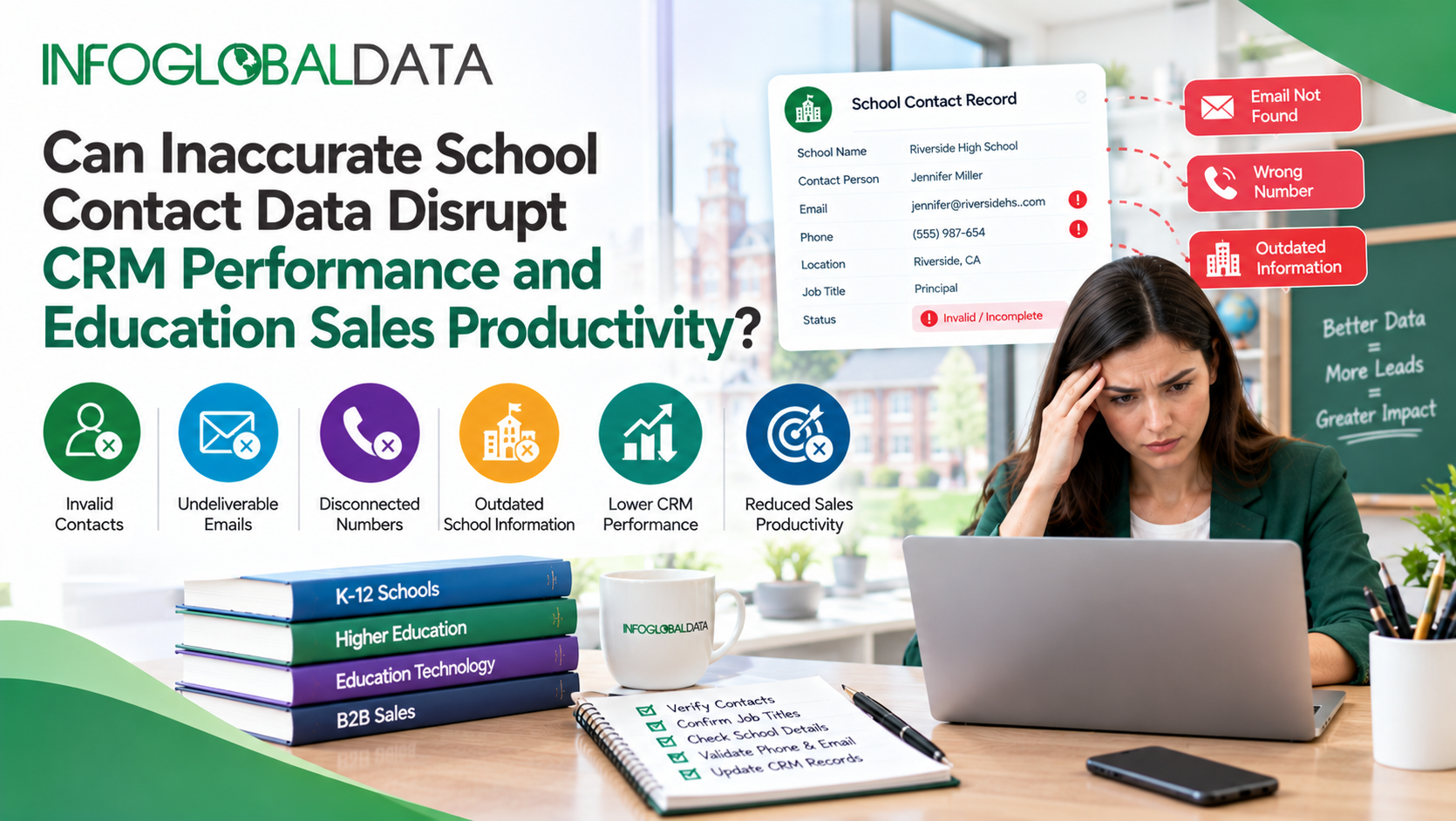
Can Inaccurate School Contact Data Disrupt CRM Performance and Education Sales Productivity? | InfoGlobalData

School sales teams depend on accurate contact information to reach superintendents, principals, district administrators, technology directors, procurement officers, and other education decision-makers. When these records contain former employees, outdated job titles, incorrect email addresses, or duplicate school accounts, even well-planned campaigns can lose effectiveness. The challenge is particularly relevant in K–12 education, where leadership changes and budget pressures can alter purchasing responsibilities. ILO Group's September 2026 update found that 17.4% of the 500 largest U.S. school districts changed superintendents during the 2025–26 school year. This article examines how inaccurate school contact data affects CRM performance, sales productivity, and education-sector outreach—and how organizations can improve the quality of their records.
1. Leadership changes can make school contact records outdated
School districts operate through leadership structures that can change over time. Superintendents, principals, chief academic officers, technology directors, and business administrators may leave, move into new roles, or take responsibility for different departments. When these changes are not reflected in CRM records, sales representatives risk contacting people who no longer influence purchasing decisions.
ILO Group's September 2026 Superintendent Research Project found that 87 of the 500 largest U.S. school districts (17.4%) changed superintendents during 2025–26. Although this was the lowest turnover rate since before the pandemic, the same research found that only 78 of the 500 leaders who were in office in March 2020 remained in their original positions.
This illustrates why school contact records need ongoing review. A district may retain its name, website, and administrative office while its leadership team changes. A salesperson using an outdated School Email Database might continue contacting a former superintendent or overlook the newly appointed administrator.
The impact extends beyond superintendent records. Changes among principals, curriculum leaders, technology administrators, and procurement staff can also affect the relevance of education-sector campaigns.
2. Poor CRM data can reduce sales productivity
CRM systems help education vendors manage prospects, track conversations, coordinate follow-ups, and prioritize accounts. However, these functions depend on reliable information. Incorrect email addresses, missing job titles, and duplicate records can create unnecessary work for sales representatives.
Validity's State of CRM Data Management in 2025 surveyed 602 CRM users and stakeholders across the United States, United Kingdom, and Australia. It found that 76% said less than half of their organization's CRM data was accurate and complete. Additionally, 37% reported that poor data quality had caused their organization to lose revenue. These are cross-industry survey findings, not education-specific measurements, but they demonstrate the wider business consequences of unreliable CRM information.
In education sales, poor contact data can create several operational problems:
-
Wasted outreach: Sales representatives spend time contacting former administrators or incorrect departments.
-
Delayed follow-ups: Messages reach inactive email accounts or employees who no longer manage the relevant function.
-
Duplicate communication: Multiple representatives may contact the same school or district using separate records.
-
Weak campaign reporting: Duplicate or inaccurate records distort engagement and conversion measurements.
-
Missed opportunities: New decision-makers may not be included in prospecting campaigns.
A well-maintained School Mailing List helps reduce these problems by giving sales teams a more reliable starting point for account research and outreach.
3. Education purchasing decisions involve multiple stakeholders
One reason school contact accuracy matters is that education purchasing is rarely controlled by a single person. Depending on the product or service, decisions may involve superintendents, principals, curriculum directors, IT administrators, finance officers, procurement teams, and school boards.
McKinsey's July 2025 survey of more than 300 administrators in U.S. public and charter school districts included superintendents, chief academic officers, chief technology officers, and chief business and operations officers. The study examined how district leaders expected funding conditions and spending priorities to evolve over the following three school years.
This range of participating roles reflects the different responsibilities involved in district-level planning. For example:
-
Educational technology: Technology directors and IT administrators may assess infrastructure, cybersecurity, and system compatibility.
-
Instructional products: Curriculum leaders and academic officers may evaluate alignment with teaching priorities.
-
School supplies: Procurement and business officers may manage purchasing procedures and budgets.
-
Administrative software: Superintendents, finance leaders, and technology teams may participate in evaluation and approval.
A generic list of school addresses cannot provide this level of targeting. Marketers need records segmented by institution type, administrative role, district, and location. Accurate School Email Lists make it easier to identify relevant contacts, while account research helps determine who actually participates in a specific buying process.
4. Budget pressure makes accurate targeting more important
School districts face financial constraints that can affect purchasing timelines, vendor evaluations, and technology investments. Contacting the wrong administrator can waste valuable sales time, particularly when education organizations are reviewing spending priorities carefully.
McKinsey's September 2025 analysis, based on its survey of more than 300 K–12 district administrators, projected that per-pupil spending in traditional public and charter schools could remain flat in nominal terms during the 2025–26 and 2026–27 school years. Its model also projected total K–12 funding of approximately $969 billion in 2025–26 and $972 billion in 2026–27. These are model projections rather than confirmed final spending figures.
For education vendors, this environment makes account qualification especially important. A product may be relevant to a school but still require approval from a district-level budget holder or procurement team. Repeatedly contacting an administrator who has no purchasing authority is unlikely to improve sales productivity.
A current School Email Database can support more focused prospecting by helping teams distinguish between school-level and district-level contacts. Combining role-based segmentation with research into funding priorities, procurement processes, and product requirements can make outreach more relevant.
5. Technology changes increase the need for accurate education contacts
Schools and districts continue to evaluate technology for teaching, administration, infrastructure, and student services. As these systems become more interconnected, vendors may need to communicate with several departments rather than relying on a single general contact.
CoSN's 2025 State of EdTech District Leadership report was based on 645 surveys completed by education technology leaders in U.S. school systems between January and March 2025. The report examined developments in artificial intelligence, cybersecurity, digital connectivity, strategic initiatives, staffing, and interoperability. It also highlighted the expanding responsibilities of education technology leaders in shaping school technology environments.
For technology providers, this creates a clear prospecting requirement: contact records should identify the administrators responsible for relevant technology functions. An outdated IT director record, for example, may direct a campaign toward someone who has moved to another district or no longer manages technology procurement.
The same principle applies to providers of learning platforms, assessment tools, cybersecurity solutions, communication systems, and administrative software. A segmented School Mailing List can help identify relevant professional roles, but vendors should verify the current responsibilities of each contact before launching a campaign.
6. What accurate school contact records should include
A useful education contact database should contain enough information to support segmentation, verification, and account-level decision-making.
|
Data field |
Why it matters |
|---|---|
|
Contact's full name |
Identifies the administrator and helps prevent duplicate records. |
|
Current job title |
Shows the person's present responsibilities. |
|
School or district name |
Connects the contact to the correct institution. |
|
Verified business email |
Supports professional outreach and email validation. |
|
Institution type |
Distinguishes public, private, charter, and other school categories. |
|
Location |
Enables geographic targeting and territory planning. |
|
Department or function |
Helps identify relevant academic, administrative, or technology contacts. |
|
Verification date |
Shows when the record was last reviewed. |
|
Source or update history |
Helps assess record reliability and trace changes. |
These fields should be maintained at both contact and organization levels. If a principal changes schools, the person's employment information must be updated. If a district reorganizes its departments, related account records and reporting relationships may also need revision.
7. Practical steps to improve education sales productivity
Sales and marketing teams can strengthen CRM performance by making contact-data maintenance part of their regular workflow.
-
Review leadership changes: Monitor official school and district websites, appointment announcements, and credible education publications for changes in administrative roles.
-
Validate contact details: Check names, titles, institutional affiliations, and business email addresses before adding records to active campaigns.
-
Segment by role and institution: Separate principals, superintendents, technology directors, academic administrators, and procurement contacts. Distinguish individual schools from district offices.
-
Remove duplicates and obsolete records: Merge duplicate accounts where appropriate and mark former employees or inactive contacts clearly.
-
Schedule regular database reviews: Prioritize high-value districts and frequently changing contacts while maintaining a recurring validation process for the wider database.
InfoGlobalData can be considered as a resource for businesses seeking targeted B2B education contact data. When evaluating any provider, teams should look beyond list size and assess data coverage, role accuracy, verification practices, update frequency, and compliance procedures.
Conclusion
Inaccurate school contact data can weaken CRM performance by creating unnecessary outreach, delaying follow-ups, distorting campaign reporting, and making it harder to reach education decision-makers. Leadership changes, evolving technology responsibilities, and school budget pressures make reliable records particularly important for education vendors. Research from ILO Group, Validity, McKinsey, and CoSN highlights the importance of tracking organizational changes and understanding how school systems operate. Maintaining accurate School Email Lists requires regular verification, role-based segmentation, and consistent CRM updates. By treating contact data as an ongoing business asset rather than a one-time acquisition, sales teams can improve prospecting efficiency and build more relevant relationships with schools and districts.
Frequently Asked Questions
1. Why is accurate school contact data important for CRM performance?
Accurate school contact data helps sales teams reach current administrators, reduce duplicate outreach, and maintain reliable account records. It also improves campaign segmentation and makes follow-up activities more efficient.
2. What information should School Email Lists include?
Useful records should include contact names, current job titles, school or district names, verified business emails, institution types, locations, and verification dates. Department or functional information can further improve targeting.
3. How often should a School Email Database be updated?
There is no universal update schedule for every school or district. High-priority contacts should be reviewed regularly, and records should be checked whenever leadership announcements, staff changes, or organizational restructuring occur.
4. How does school leadership turnover affect education sales?
When principals, superintendents, or district administrators leave their roles, existing contact records may become outdated. Sales teams may need to identify replacement decision-makers and update account relationships to keep outreach relevant.
5. How can education vendors improve their School Mailing List?
Vendors can improve list quality by validating email addresses, checking current job titles, removing duplicate records, monitoring leadership changes, and segmenting contacts by institution type and department.
6. Who are the main decision-makers for education technology purchases?
Depending on the product and district structure, decision-makers may include technology directors, superintendents, chief academic officers, principals, finance officers, and procurement administrators. Vendors should research the buying process for each target institution rather than assuming one role controls every purchase.
7. Can inaccurate school email addresses affect campaign results?
Yes. Incorrect or inactive addresses can contribute to delivery failures and make campaign reporting less reliable. Regular verification and record maintenance help teams identify problems before launching large outreach campaigns.


