
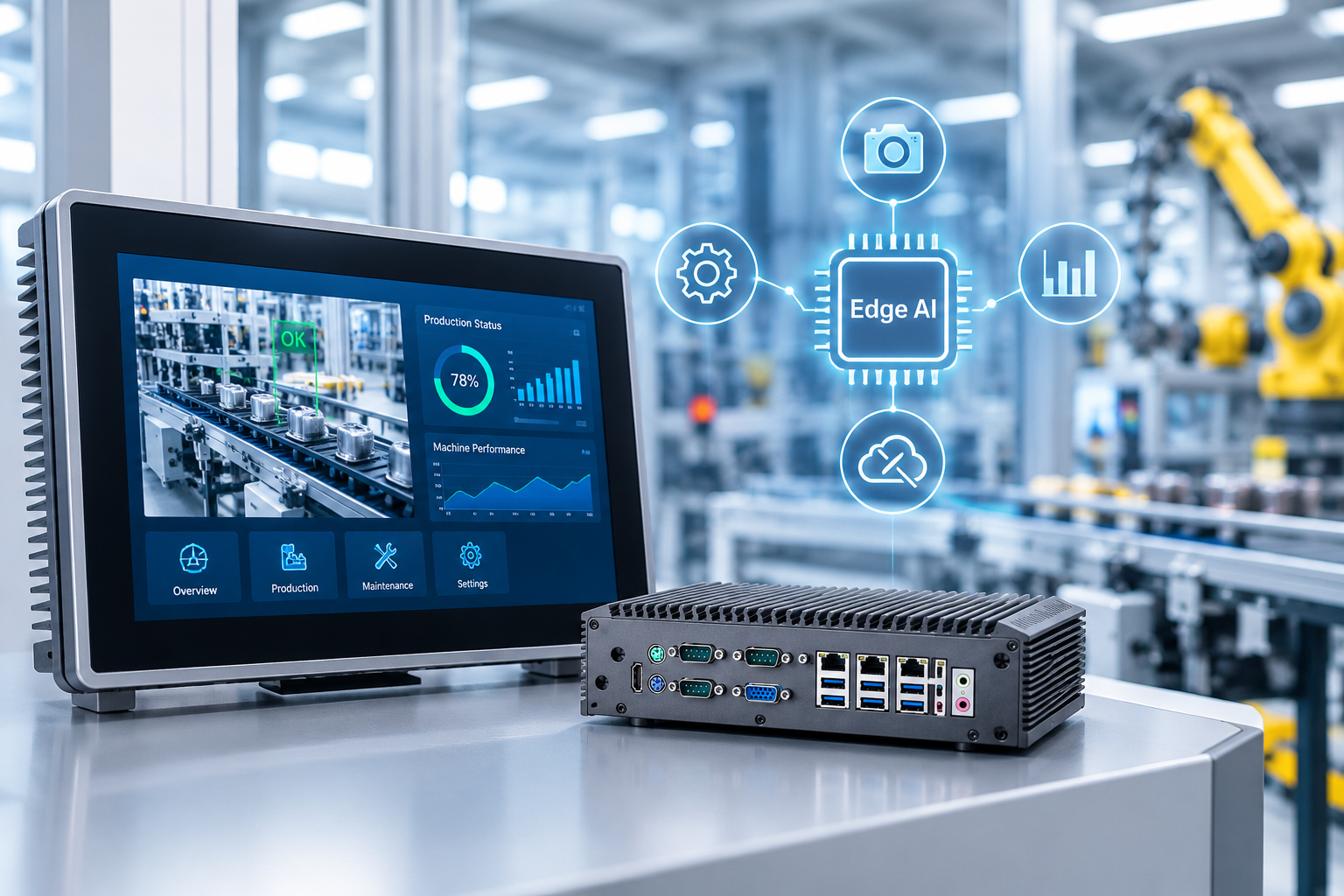
Industrial Panel Computers and Edge AI: The Next Step in Factory Automation

Factory automation is changing rapidly. Manufacturers are no longer looking only for systems that display machine data. They want intelligent solutions that can analyse information, identify production issues and support faster decisions.
This is where Industrial Panel Computers and Edge AI are becoming increasingly important.
By combining industrial computing hardware with local data processing, manufacturers can improve machine monitoring, production visibility and automation workflows. For OEMs and machine builders, choosing the right Industrial Panel PC is an important step towards building smarter and more connected machines.
1. What Is Edge AI in Industrial Automation?
Edge AI means processing data close to where it is generated rather than sending all information to a remote cloud server.
In manufacturing environments, data comes from sensors, cameras, machines, PLCs and connected equipment. Edge computing allows suitable hardware to analyse this information locally.
For example, an AI-based inspection system can analyse product images to identify defects during production. Similarly, sensor data can be evaluated to detect unusual machine behaviour and support predictive maintenance.
This approach can reduce dependence on continuous cloud connectivity, minimise unnecessary data transfers and provide faster access to relevant information.
2. Why Are Industrial Panel Computers Important?
An Industrial Panel Computer combines a display, touchscreen and computing hardware in one integrated device. It provides operators with a convenient interface for monitoring machines, viewing production information and interacting with industrial applications.
When equipped with suitable processing capabilities, it can also support selected Edge AI applications.
Key benefits include:
- Local data processing: Analyse selected machine and sensor data closer to the production environment.
- Real-time monitoring: Display machine status, production information and system alerts.
- Simplified integration: Connect with compatible industrial devices and automation systems.
- Reduced cloud dependency: Support applications designed to operate locally.
- Improved operator interaction: Provide a central touchscreen interface for HMI and production applications.
However, not every Industrial Panel PC can handle demanding AI workloads. Hardware selection must match the actual application requirements.
3. Industrial Applications of Edge AI Panel Computers
Industrial Panel PCs and Edge AI can support several manufacturing applications.
AI-Based Quality Inspection
Computer vision applications can analyse images to identify surface defects, missing components, incorrect assembly and packaging problems. Suitable computing hardware processes the images and displays inspection results.
Predictive Maintenance
Industrial sensors collect information about temperature, vibration and equipment performance. Edge applications can analyse this data to identify unusual patterns and help maintenance teams investigate potential equipment problems.
Production Monitoring
Industrial Panel Computers can display machine status, production quantities, downtime and operating conditions. Combined with suitable analytics software, they help manufacturers understand production performance.
Energy Monitoring
Connected meters and sensors can provide information about energy consumption. Local processing can help identify usage patterns and support better energy management.
4. What Should You Check Before Buying an Industrial Panel Computer?
Choosing an Industrial Panel PC for automation or Edge AI requires more than comparing screen sizes and prices.
Consider these important factors before purchasing.
Processor Performance: Check whether the processor can handle your HMI software, data processing and intended applications. Complex AI workloads may require a higher-performance CPU.
GPU or NPU Support: Machine vision and advanced AI applications may benefit from dedicated graphics or AI acceleration. Confirm compatibility with your intended AI software.
RAM and Storage: Evaluate memory capacity, SSD storage and future expansion requirements. Multiple applications and local data logging may require additional resources.
Display and Touchscreen: Consider screen size, resolution, brightness and touchscreen technology. A 15.6-inch Full HD display can be useful for applications requiring detailed dashboards and visualisation.
Industrial Protection: Check IP protection, operating temperature, cooling design, vibration resistance and power requirements. These specifications should match the actual factory environment.
Connectivity: Ethernet, USB, serial ports and other industrial interfaces may be necessary to connect PLCs, sensors, cameras and external equipment.
Operating System Compatibility: Confirm support for the required Windows or Linux environment, drivers, HMI software and AI frameworks before making a purchase.
5. Industrial Panel PC vs. Industrial Box PC: Which Should You Choose?
Both solutions have an important role in industrial automation.
An Industrial Panel PC combines computing hardware and a touchscreen in one unit. It is suitable when operators need direct access to machine information and control applications.
An Industrial Box PC separates the computing unit from the display. It offers flexibility when selecting screen size, mounting position and computing configuration.
For applications requiring AI processing, compare the processor, GPU or NPU capabilities, cooling design and software compatibility of both solutions.
The right choice depends on your machine design, installation requirements and application workload.
6. Common Mistakes When Buying an Industrial Panel PC
Before selecting a device, avoid these common mistakes:
- Choosing a processor without evaluating the actual software workload.
- Ignoring thermal requirements for continuous operation.
- Overlooking essential Ethernet, USB or serial interfaces.
- Assuming every industrial touchscreen computer supports AI applications.
- Not checking operating system and software compatibility.
- Ignoring product availability, technical support and long-term replacement options.
For OEMs and machine builders, considering these factors early can help reduce integration problems and unnecessary costs.
7. Looking for the Right Industrial Panel Computer?
Industrial automation is moving towards more connected, intelligent and data-driven systems. Selecting suitable computing hardware can help manufacturers prepare their machines for future requirements.
At Pericom, you can explore industrial computing solutions for automation, machine building and industrial applications.
One option to consider is the Siemens-certified Industrial Edge Panel PC NPP-156P01, featuring a 15.6-inch Full HD touchscreen and an industrial computing platform.
It can be evaluated for HMI, operator-interface and connected industrial applications. For demanding AI inference or machine-vision workloads, confirm the required processing performance and software compatibility before selecting it.
Planning an industrial automation or Edge computing project?
Contact Pericom to discuss your application requirements and find a suitable Industrial Panel Computer for your project.
Frequently Asked Questions
1. Can an Industrial Panel PC run Edge AI?
Yes, if its processor, memory, graphics or AI accelerator and software support the intended workload.
2. What is the difference between an Industrial Panel PC and an HMI?
An HMI is the operator interface used to interact with machines. An Industrial Panel PC is the computing hardware that can run HMI software and other applications.
3. What should I consider when buying an Industrial Panel Computer?
Check processor performance, RAM, storage, display, touchscreen, IP protection, connectivity, operating system compatibility and long-term support.
Read More: https://tecsysproductguides.blogspot.com/2026/10/industrial-panel-computers-and-edge-ai.html


