
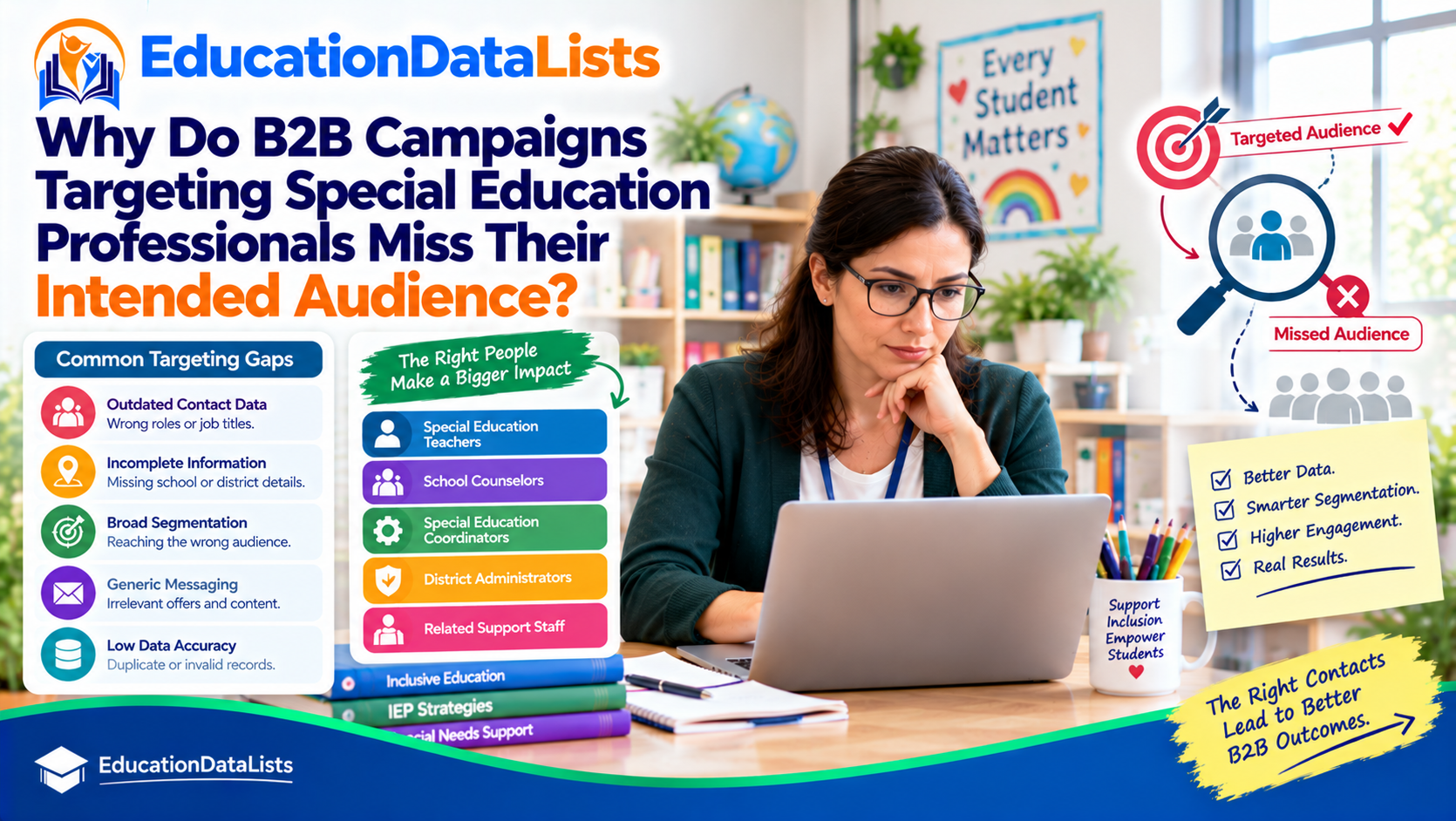
Why Do B2B Campaigns Targeting Special Education Professionals Miss Their Intended Audience? | EducationDataLists

Introduction
B2B campaigns targeting special education professionals can miss their intended audience even when the email list appears relevant. Outdated job titles, incorrect school affiliations, weak segmentation, and generic messaging can prevent vendors from reaching the educators who actually evaluate or use their solutions. The consequences matter in a sector with substantial staffing pressures: the National Center for Education Statistics (NCES) reported that 72% of public schools with special education teaching vacancies experienced difficulty filling those positions with fully certified teachers for the 2024–25 school year.
For companies selling assistive technology, specialized curricula, assessment tools, classroom resources, or professional development, effective outreach requires more than a large Special Education Teacher Email List. It requires accurate contact records, a clear understanding of school structures, relevant messaging, and ongoing performance measurement.
1. Outdated Job Titles and Inaccurate Contact Records
One of the most common reasons campaigns miss their intended audience is that contact information no longer reflects the person’s current role. A teacher may have moved schools, changed responsibilities, or left the profession, while the old email address remains in a database.
A reliable contact record should include:
-
Full name and current professional title
-
School and district affiliation
-
Grade levels or program specialization, where verified
-
Professional email address and validation status
-
Source and last verification date
-
Relevant decision-making or purchasing role
The scale of CRM data problems provides useful context. Validity’s State of CRM Data Management in 2025 report, based on 602 CRM users and stakeholders, found that 76% of respondents said less than half of their organization’s CRM data was accurate and complete. The finding is cross-industry rather than specific to education, but it illustrates how inaccurate records can undermine targeting and personalization.
For marketers, the lesson is straightforward: email validation and professional verification are separate tasks. An address may be technically deliverable without confirming that the person is still a special education teacher at the listed school.
2. Treating Every Special Education Professional as the Same Audience
Special education is not a single, uniform job category. Professionals may teach students with different support needs, work across grade levels, coordinate individualized education programs (IEPs), or serve in specialist roles. A campaign that treats all contacts as interchangeable can offer resources that do not match their responsibilities.
Federal data demonstrates the scale and diversity of the field. The U.S. Department of Education’s 2025 Annual Report to Congress on the Individuals with Disabilities Education Act (IDEA) states that more than 8 million children were served under IDEA in 2024. Its findings also identify specific learning disabilities as the most prevalent disability category among school-age students served under IDEA Part B. These are student-service figures, not counts of teachers or prospective buyers.
A more useful Special Education Teacher Mailing List separates contacts into relevant groups, such as:
-
Early childhood and preschool special education
-
Elementary, middle, and high school settings
-
Learning-support and intervention roles
-
Special education department leadership
-
Assistive technology and accessibility specialists
-
District-level special education administrators
Segmentation should rely on verified professional information. Do not infer that a teacher works with a particular disability category simply because of their school or job title.
3. Ignoring School and District Decision-Making Structures
A campaign can reach the correct teacher and still fail if the offer requires approval from someone else. Classroom educators may use a resource directly, while department leaders, district administrators, technology teams, or procurement staff influence whether it is purchased.
This distinction matters because public schools operate within formal service and administrative structures. Under IDEA, eligible students are entitled to a free appropriate public education, with special education and related services delivered according to applicable requirements. Districts must coordinate services and resources, but purchasing processes and responsibilities vary by state and local system.
For B2B marketers, the contact record should distinguish between:
-
Users: Teachers and specialists who use the product
-
Influencers: Professionals who evaluate or recommend it
-
Decision-makers: Administrators with approval authority
-
Procurement stakeholders: Staff who manage purchasing procedures
For example, a company offering classroom-level instructional materials may begin with teachers and special education coordinators. A vendor selling district-wide software may need to include special education directors, IT leaders, and procurement contacts.
The goal is not to replace teacher outreach with administrator outreach. It is to map the relevant buying group so that the campaign reaches both the people who understand classroom needs and the people who can authorize adoption.
4. Generic Messaging That Does Not Reflect Educators’ Needs
Even accurate contact data cannot compensate for irrelevant messaging. A generic email promoting a broad education product may fail to explain how it helps a special education professional address a specific instructional or administrative challenge.
Staffing pressures make relevance especially important. NCES reported that 34% of public schools said they were understaffed in special education positions in October 2024. This finding reflects school leaders’ reports at that time; it does not mean every school faces the same staffing problem.
A useful campaign should connect the offer to a credible, relevant benefit, such as reducing repetitive administrative work, supporting accessible instruction, organizing progress-monitoring information, or helping educators use instructional materials more efficiently.
Before sending, ask:
-
Does the message relate to the recipient’s actual role?
-
Is the benefit specific rather than generic?
-
Can the claim be supported by product evidence?
-
Is the proposed action realistic for a busy educator?
-
Does the message distinguish between classroom use and district-level adoption?
Avoid implying that a school has a particular student need or resource shortage unless that information is documented. Personalization should improve relevance without making assumptions about individual students or their circumstances.
5. Poor List Segmentation and Weak Data Provenance
A Special Education Teacher Email Database should explain not only who the contact is, but also why the record belongs in a particular campaign. When the source, verification date, or segment definition is missing, teams cannot easily determine whether poor results stem from the message, the audience, or the underlying data.
Recommended fields include:
-
School and district identifiers, where available
-
Public or private school classification
-
Grade span and school type
-
Professional role and verified specialization
-
Email validation status
-
Original source and last verification date
-
Campaign segment and reason for inclusion
-
Unsubscribe and do-not-contact status
NCES provides public-school and district directory information through the Common Core of Data, including organizational identifiers and school characteristics. These resources can help marketers structure account records, but they do not replace individual verification of a teacher’s current role or email address.
Use data provenance to identify which fields come from official directories, professional sources, or third-party providers. Where information cannot be confirmed, mark it as unknown rather than treating an assumption as a fact.
6. Measuring the Wrong Campaign Metrics
A campaign may report strong delivery or click rates while generating few relevant conversations. If performance is measured only by the number of emails sent or opened, teams can overlook the underlying reasons their outreach misses the intended audience.
Measure the full funnel:
| Metric | What it helps diagnose |
|---|---|
| Valid email rate | Whether contact channels appear usable |
| Role and school accuracy | Whether records match the intended audience |
| Bounce rate | Possible data or deliverability problems |
| Positive reply rate | Whether messaging generates relevant interest |
| Qualified meeting rate | Whether engagement converts into useful conversations |
| Opportunity conversion | Whether outreach supports commercial progress |
| Unsubscribe and complaint rates | Whether targeting or messaging may be poorly aligned |
Validity’s 2025 report also found that 37% of respondents reported revenue losses associated with poor data quality. This is a survey finding across CRM users, not an estimate of losses from special education email campaigns specifically. It nevertheless reinforces the need to treat data quality as a business performance issue.
Review performance by segment rather than only at the campaign level. If one group produces more bounces or fewer qualified replies, investigate its source, role definitions, and messaging before increasing send volume.
7. Five Practical Ways to Reach the Right Audience
-
Verify contacts before launch. Check the current school, job title, email status, and source date for priority records.
-
Build role-based segments. Separate classroom teachers, specialists, coordinators, and district decision-makers where relevant.
-
Match the offer to the audience. Explain the practical value for the recipient’s responsibilities instead of sending one generic message to everyone.
-
Connect list data to CRM outcomes. Track replies, qualified meetings, opportunities, and data-quality issues against each segment.
-
Maintain compliance and suppression records. Keep opt-outs accessible across systems and follow the applicable rules for commercial email.
EducationDataLists can be considered as a resource for education-sector contact research and list-building workflows. As with any data provider, marketers should assess role accuracy, available segmentation fields, sourcing, freshness, and suitability for the intended campaign before using the records.
Conclusion
B2B campaigns targeting special education professionals often miss their intended audience because the underlying contact data, audience segmentation, buying-group assumptions, or message relevance is weak. Federal education data shows both the scale of services delivered under IDEA and the staffing pressures reported by public schools, but those broad findings do not identify the needs of any individual school or educator.
A stronger approach combines verified professional records with role-based segmentation, specific and supportable messaging, and measurement beyond email opens. A well-maintained Special Education Teacher Email List should make it easier to identify the right professionals, understand their institutional context, and assess whether outreach leads to relevant conversations. By improving data quality and continuously reviewing campaign outcomes, marketers can reduce wasted activity and build more useful relationships with the educators and administrators they aim to serve.
Frequently Asked Questions
1. Why do campaigns using a Special Education Teacher Email List miss their target audience?
Common causes include outdated contact details, incorrect job titles, broad segmentation, and messages that do not match the recipient’s responsibilities. Campaigns can also underperform when teachers are contacted about products that require district-level approval.
2. What information should a special education teacher contact record include?
Useful fields include the teacher’s name, current title, school and district, professional email, source, verification date, and relevant role or specialization. Email validation, unsubscribe status, and school identifiers can further improve targeting and record management.
3. How should marketers segment a Special Education Teacher Mailing List?
Segment contacts using verified factors such as grade level, professional role, school type, and relevant specialization. Keep teachers, specialists, and purchasing stakeholders distinct when their needs or responsibilities differ.
4. How can marketers improve email relevance for special education professionals?
Connect the offer to a specific, supportable benefit related to the recipient’s role. Avoid assumptions about individual students or school needs, and use concise messages with a clear next step.
5. How often should a Special Education Teacher Email Database be updated?
There is no universal refresh schedule for every list. Verify priority contacts before campaigns, monitor bounces and role changes, and schedule reviews based on data age, source reliability, and campaign frequency.
6. Which metrics matter most when evaluating these campaigns?
Track role accuracy, valid email rate, bounces, positive replies, qualified meetings, and downstream opportunities. Reviewing results by segment helps identify whether problems originate in data quality, targeting, or messaging.
7. Does a valid email address prove that a teacher is the right prospect?
No. An address may be deliverable even if the person has changed schools or responsibilities. Verify professional identity, school affiliation, and relevance separately.


