
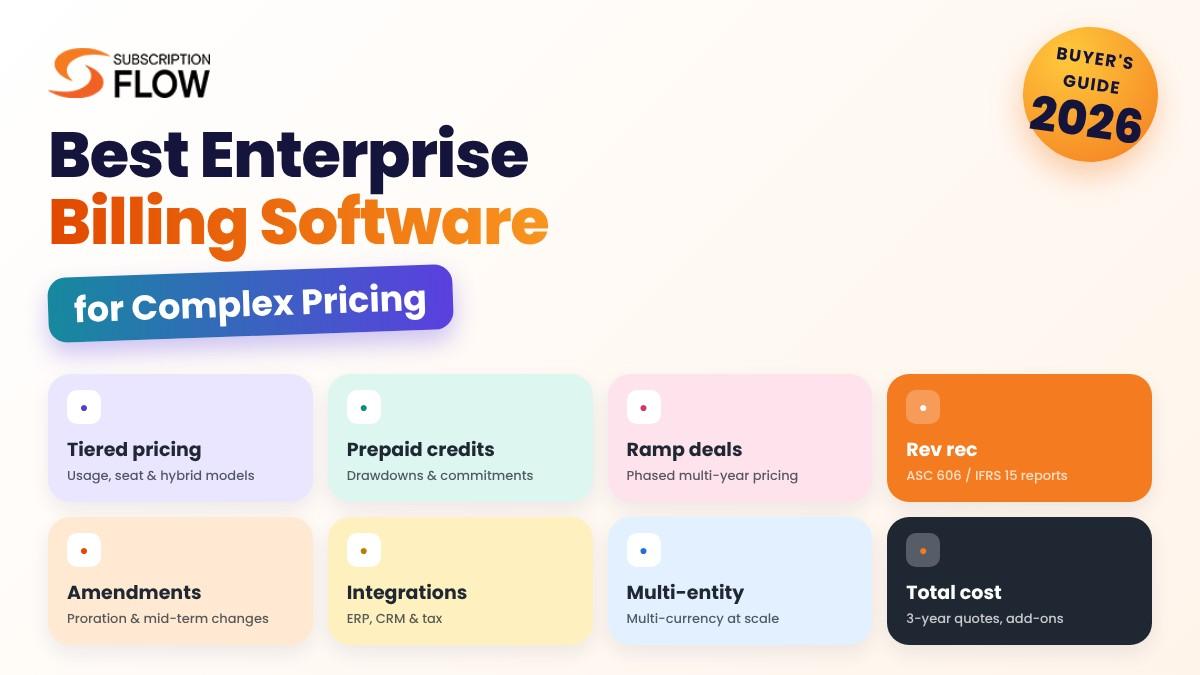

As businesses move beyond traditional flat-rate subscriptions, managing complex pricing structures has become an important part of revenue operations. Usage-based billing, tiered pricing, hybrid subscriptions, prepaid credits, and customized enterprise contracts allow companies to create flexible pricing strategies that meet different customer needs. However, these models also introduce challenges involving accurate usage calculations, contract amendments, invoicing, payment collection, and revenue recognition. Enterprise billing software helps organizations automate these processes, reduce manual errors, and maintain greater control over recurring revenue. Leading solutions such as Zuora, Chargebee, NetSuite SuiteBilling, Salesforce Revenue Cloud, BillingPlatform, and SubscriptionFlow offer different capabilities for businesses seeking to simplify complex billing operations.
What Is Complex Pricing?
Complex pricing refers to commercial arrangements that combine multiple pricing methods, usage conditions, discounts, and contractual requirements. Instead of charging a fixed monthly fee, a business may apply tiered rates, consumption-based charges, volume discounts, prepaid credits, one-time fees, and customized enterprise agreements. Some contracts also include ramp pricing, where subscription prices change during specific periods, or hybrid models that combine a recurring base fee with additional usage charges. Managing these arrangements manually can lead to billing discrepancies, delayed invoices, and difficulties forecasting revenue. Enterprise billing platforms help businesses manage these pricing structures through automated rating engines, configurable billing rules, and integrated subscription management workflows.
Essential Features of Enterprise Billing Software
Selecting the right billing platform requires evaluating how effectively it handles a company's pricing requirements and financial workflows. A robust rating engine should calculate charges based on usage, pricing tiers, volume thresholds, discounts, and negotiated customer rates. Hybrid billing capabilities should support recurring subscriptions, one-time charges, usage fees, and overages within the same agreement. Businesses should also assess support for contract amendments, renewals, prorated charges, multi-currency transactions, tax management, and integrations with CRM and ERP systems. Revenue recognition, security controls, implementation flexibility, reporting capabilities, and transparent total ownership costs are equally important. The most suitable solution is one that supports existing requirements while allowing the business to introduce new pricing models without excessive development work.
Zuora: Enterprise Billing for Complex Subscription Contracts
Zuora is an enterprise subscription management platform designed to support recurring billing, consumption-based pricing, contract amendments, and revenue operations. Its billing capabilities help businesses manage customized price schedules, tiered rates, ramp deals, and evolving subscription agreements. Zuora also offers a separate revenue management solution to support complex revenue recognition workflows. These features make it a potential choice for large organizations with extensive subscription portfolios, sophisticated contract terms, and multiple financial system integrations. However, implementation requirements, platform complexity, and overall costs should be evaluated carefully. Companies considering Zuora should request a tailored quotation and assess the resources needed to configure, maintain, and optimize the platform.
Chargebee: Subscription Billing for Growing SaaS Businesses
Chargebee provides subscription billing and revenue management tools for SaaS companies that need to automate recurring payments and introduce flexible pricing models. Its capabilities include subscription lifecycle management, usage-based billing, hybrid pricing, hosted checkout, customer self-service portals, and payment gateway integrations. The platform can help growing businesses launch pricing changes and streamline payment collection without relying entirely on manual processes. Additional products support revenue recognition and retention management, although certain capabilities may require separate subscriptions. Before choosing Chargebee, businesses should review its customization options, billing-volume thresholds, integration requirements, and enterprise pricing structure to determine whether it can accommodate their expected growth.
NetSuite SuiteBilling: Subscription Billing Integrated With ERP
NetSuite SuiteBilling is a subscription billing module within the Oracle NetSuite ecosystem. It enables organizations to manage recurring charges, usage-based pricing, subscription changes, and customer billing alongside their broader financial operations. When combined with NetSuite revenue management capabilities, it can support revenue recognition workflows and help finance teams maintain consistent records. This integration can be particularly valuable for companies that already use NetSuite as their primary ERP system. However, organizations should account for ERP licensing, implementation costs, usage data integrations, and the training required to operate the system effectively. Businesses without an existing NetSuite environment should compare the overall investment against more specialized subscription billing platforms.
Salesforce Revenue Cloud: Connected Quote-to-Cash Management
Salesforce Revenue Cloud connects product configuration, pricing, quoting, order management, and billing workflows within the Salesforce ecosystem. It helps businesses align commercial agreements with downstream sales and financial operations, reducing the disconnect that can occur between quoting and invoicing. Organizations with negotiated contracts, complex product catalogs, and subscription-based offerings may benefit from this connected approach. Its suitability depends on the required product edition, existing Salesforce licenses, integration needs, and implementation scope. Businesses already using Salesforce extensively should evaluate whether Revenue Cloud provides the right balance of billing functionality, workflow automation, and financial visibility for their operations.
BillingPlatform: Advanced Rating for High-Volume Usage
BillingPlatform is designed for organizations that require advanced usage mediation, pricing calculations, invoicing, and revenue lifecycle management. Its capabilities support complex pricing formulas, tiered and volume-based rates, multiple usage data sources, and hierarchical customer account structures. These features can benefit telecommunications providers, technology companies, and enterprises that process substantial consumption data across multiple business units. Nevertheless, implementation complexity, data quality, integration requirements, and ongoing administration should be considered before adoption. Since enterprise pricing depends on individual requirements, prospective customers should request a detailed quotation based on transaction volumes, selected modules, integrations, and implementation needs.
Comparing Enterprise Billing Software for Complex Pricing
Each enterprise billing platform addresses a different combination of business requirements. Zuora may be suitable for organizations managing complex subscription contracts and frequent amendments, while Chargebee can appeal to growing SaaS businesses seeking flexible subscription billing. NetSuite SuiteBilling is worth evaluating when an organization already relies on NetSuite for financial management, whereas Salesforce Revenue Cloud can benefit businesses with Salesforce-centered sales and customer operations. BillingPlatform may be appropriate for enterprises processing large volumes of usage data and requiring advanced rating capabilities. SubscriptionFlow is another option for businesses seeking a combination of subscription management, usage-based billing, hybrid pricing, and payment automation. Comparing these solutions against real pricing scenarios, integration requirements, and long-term operating costs helps businesses identify the most appropriate platform.
Security, Compliance, and Data Protection
Enterprise billing platforms process customer information, payment-related data, invoices, and financial records, making security a critical consideration. Businesses should examine relevant certifications, independent audit reports, encryption practices, role-based access controls, audit trails, and incident response procedures. They should also understand how payment details are stored or tokenized and which parties are responsible for applicable PCI DSS requirements. Companies operating across different jurisdictions should review data residency options, privacy obligations, and vendor data processing agreements. Security documentation should cover the exact services being purchased, and organizations should verify the scope and validity of relevant certifications before implementation. Evaluating these requirements early can help reduce risk and strengthen financial governance.
Implementation Challenges and Total Cost of Ownership
The cost of enterprise billing software extends beyond its advertised subscription or licensing fee. Additional expenses can include implementation services, integrations, premium modules, support, user licenses, and ongoing maintenance. Businesses should request multi-year quotations that reflect their actual invoice volumes, usage events, number of entities, and required functionality. Data quality is another essential factor because inaccurate contract information or incomplete usage records can undermine billing accuracy regardless of the platform selected. Organizations should also distinguish between invoicing and revenue recognition, confirming whether their chosen solution supports the necessary accounting workflows directly or requires a separate product. A phased migration, with parallel billing tests and clearly defined success metrics, can help reduce disruption and improve implementation outcomes.
How to Choose the Right Enterprise Billing Solution
Businesses should begin by identifying their most demanding pricing scenarios and the systems their teams already use. Organizations running NetSuite may prioritize SuiteBilling, while Salesforce-focused companies may benefit from Revenue Cloud. Enterprises with substantial usage volumes or multiple billing entities can compare Zuora and BillingPlatform. Growing SaaS businesses looking for flexible subscription, usage-based, and hybrid billing may consider Chargebee and SubscriptionFlow. Before making a decision, companies should ask each vendor to demonstrate how its software handles usage calculations, pricing changes, mid-cycle upgrades, prorations, discounts, renewals, and revenue reporting. Evaluating these scenarios alongside implementation timelines, security requirements, and total ownership costs provides a more reliable basis for selecting a billing platform.
How SubscriptionFlow Stands Out in Enterprise Billing
SubscriptionFlow stands out by combining subscription management, flexible billing, payment automation, and revenue analytics within a unified platform. Businesses can manage recurring subscriptions, usage-based charges, tiered pricing, hybrid billing models, and customized pricing structures while automating processes such as proration, dunning management, and tax handling. Its payment gateway routing capabilities help businesses manage payment processing across supported providers, while CRM functionality and subscription analytics provide visibility into customer relationships and recurring revenue performance. SubscriptionFlow also offers published pricing plans that help businesses evaluate entry-level costs, alongside customized enterprise options for more advanced requirements. For mid-market organizations and growing enterprises seeking adaptable billing workflows without committing to an unnecessarily extensive ERP-style implementation, SubscriptionFlow is a compelling option to evaluate. Companies can explore its capabilities through a personalized demo and assess how its billing functionality aligns with their current pricing model, operational needs, and long-term growth strategy.
Conclusion
Complex pricing requires more than a conventional invoicing solution. Businesses need enterprise billing software that can accurately rate usage, manage evolving subscription contracts, automate payment workflows, and integrate with financial systems. Zuora, Chargebee, NetSuite SuiteBilling, Salesforce Revenue Cloud, and BillingPlatform each offer capabilities suited to different operational requirements. SubscriptionFlow provides another option for businesses seeking flexible subscription and usage-based billing combined with payment automation and lifecycle management. Ultimately, the right platform depends on pricing complexity, business scale, existing technology, revenue recognition requirements, and available resources. By testing real-world billing scenarios, verifying security controls, and comparing multi-year costs, businesses can select a solution that supports accurate billing today and adapts to new pricing strategies as they grow.


