
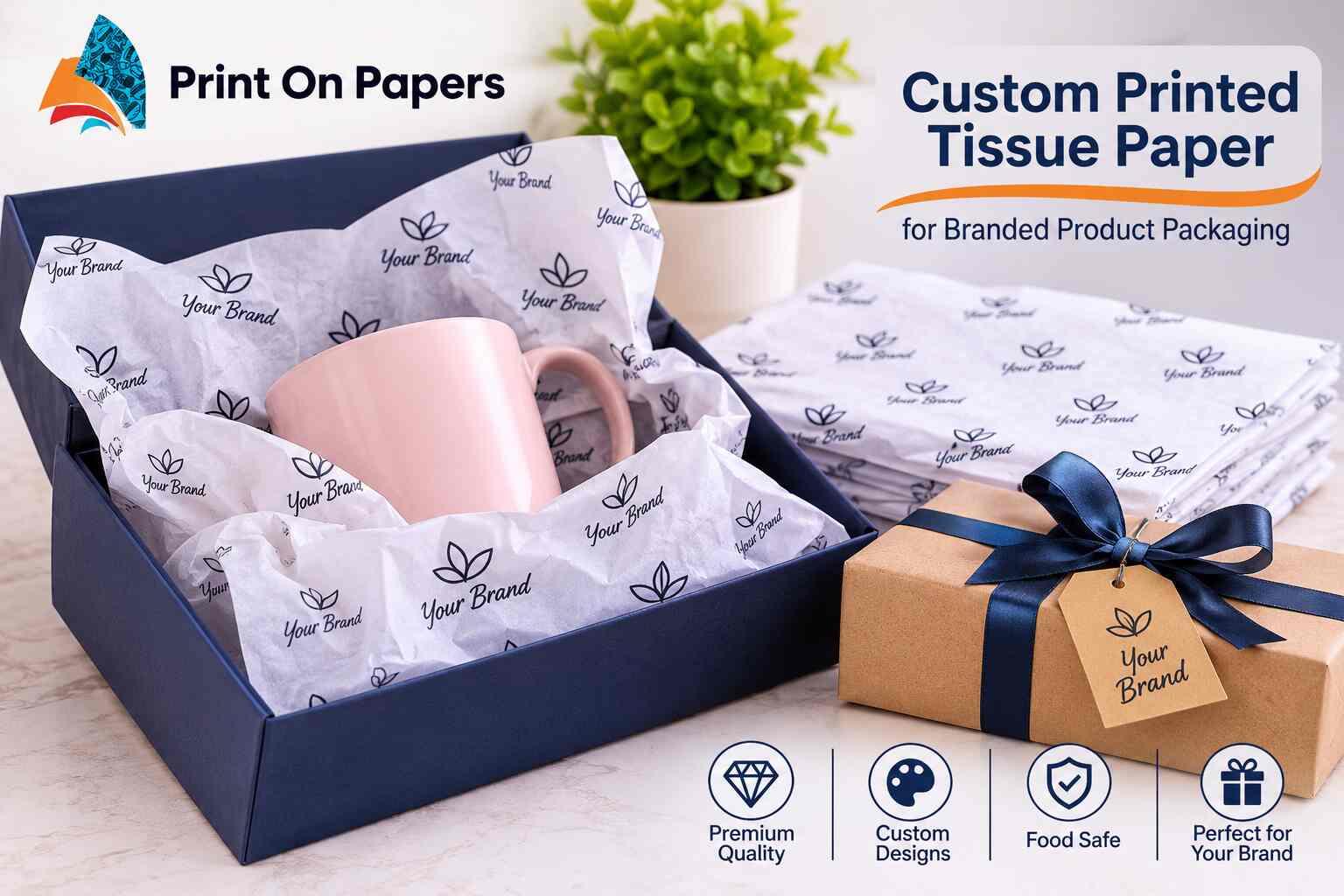

Custom printed tissue paper is a thin, branded wrapping sheet that carries your logo and colors around a product before the customer sees it. It works for gift boxes, bakery orders, apparel and e-commerce parcels. This guide covers paper weights, materials, printing methods, food safety and ordering, so you can choose a sheet that suits your product and budget.
What Is Custom Printed Tissue Paper?
Custom printed tissue paper is lightweight paper printed with your artwork, used to wrap, line or cushion a product inside its packaging. It sits between your product and your customer, so it is often the first thing they touch.
Most businesses use it in three ways:
- Wrapping individual items such as clothing, jewelry or handmade goods
- Lining gift boxes, mailers and takeout bags
- Covering baked goods, deli items or sandwiches (when the paper is food-safe)
Because it adds almost no weight to a parcel, it raises perceived value without raising shipping costs.
Why Does Branded Tissue Paper Matter for Packaging?
Branded tissue paper turns ordinary packaging into a visible brand touchpoint. A plain white sheet says nothing about who made the product, while a printed one repeats your logo, colors and style every time a customer opens an order.
There are practical benefits too:
- Unboxing appeal: customers are more likely to photograph and share a package that looks considered.
- Product protection: a wrap layer reduces scuffs on boxes, jewelry and folded clothing.
- Brand consistency: matching your tissue to your boxes, labels and stickers makes the whole order look cohesive.
- Low cost per order: compared with custom boxes, tissue is one of the more affordable ways to add branding.
Which Tissue Paper Weight (GSM) Should You Choose?
For most food and retail wrapping, 28 to 30 GSM is a dependable choice. GSM stands for grams per square meter, and it tells you how thick and sturdy the sheet is. Print On Papers offers three weight ranges:
| Weight | Look and feel | Best for |
|---|---|---|
| 17 GSM | Translucent, very light | Gift wrapping, jewelry, delicate items |
| 28 to 30 GSM | Standard, opaque | Retail wrapping, bakery and food service |
| 40 GSM (kraft) | Heavier, more rigid | Larger or heavier items, artisan brands |
A lighter sheet folds neatly and keeps costs down. A heavier one resists tearing when you wrap sharp corners or pack bulkier products.
Is Lighter Tissue Always Cheaper?
Not necessarily, because price also depends on size, print colors and quantity. Lighter paper typically costs less per sheet, but if it tears during packing you lose time and material. Test a sample with your actual product before placing a large order.
Bleached White or Natural Kraft: Which Base Is Better?
Bleached white gives a clean canvas that makes colors look bright. Natural kraft gives a warm, earthy look that suits handmade goods, farmers market brands and eco-minded retail. Neither is better, so choose the one that matches your brand.
| Base | Look | Strength | Typical brand fit |
|---|---|---|---|
| Bleached white | Crisp, bright, modern | Light to standard | Boutiques, bakeries, gift shops, cosmetics |
| Natural kraft | Warm, rustic, organic | Slightly more rugged | Artisan food, craft goods, sustainable brands |
One tip: dark brand colors and fine detail usually look sharper on white, while earth tones and simple one-color logos look great on kraft.
Can Tissue Paper Be Used With Food?
Yes, if you choose a food-safe variety. Print On Papers states that its food-contact tissue uses FDA-compliant materials under 21 CFR, with PFAS-free coatings, and food-safe soy-based and water-based inks.
For bakeries, delis and cafes, a greaseproof coating is the option to look for. It keeps oils from soaking through, so your hands, counters and bags stay cleaner. For gifts, clothing and jewelry, standard uncoated tissue is enough.
What Does PFAS-Free Mean for Your Customers?
PFAS are chemicals that have been used in some grease-resistant coatings, and many food businesses now avoid them. A PFAS-free sheet gives you an easier answer when customers or health inspectors ask what your wrap is made of. Always ask your supplier to confirm the coating on the exact paper you are ordering.
How Is Custom Tissue Paper Printed?
Tissue paper is printed with either flexographic or digital printing, and the right method depends on your order size and artwork.
| Method | Best for | Good to know |
|---|---|---|
| Flexographic | High-volume runs, repeating patterns | Cost per sheet drops as quantities rise |
| Digital | Short runs, detailed or multicolor artwork | Easier for small businesses and test batches |
You can print in full-color CMYK or match exact brand colors with Pantone (PMS). The quote form also offers 1-color, 2-color and 4-color options, which helps when you want a simple logo print without paying for extra colors.
Think about pattern before you place the order. A repeating small logo looks neat on a wrapped item, while a single large logo can get cut off when the sheet is folded.
What Sizes Are Available?
Standard sizes are 9 x 12 inches, 15 x 20 inches and 20 x 30 inches, and custom dimensions are available. Sheets come pre-cut and flat, or as custom rolls for faster wrapping at the counter.
A rough guide:
- 9 x 12 in: sandwiches, cookies, jewelry boxes, small accessories
- 15 x 20 in: apparel, gift boxes, medium retail products
- 20 x 30 in: larger apparel, boxed gifts, shipping box lining
Measure your product when folded, then add a couple of inches on each side so the sheet can fully cover it with a neat overlap.
Are There Eco-Friendly Tissue Paper Options?
Yes. FSC-certified base materials are used across the range, and compostable and recyclable variants are available. FSC certification means the fiber comes from responsibly managed forests.
If you plan to mention sustainability on your packaging, be specific. The FTC's Green Guides expect environmental claims such as "compostable" or "recyclable" to be accurate and supportable, so print only what your paper actually delivers and confirm the details with your supplier.
Which Businesses Use Custom Printed Tissue Paper?
Many small and mid-sized businesses use it, not just large brands:
- Bakeries and cafes wrapping pastries, bread and takeaway orders
- Delis and food trucks that need a fast, clean wrap
- Boutiques and gift shops folding clothing, jewelry and handmade items
- E-commerce brands creating a branded unboxing experience
- Florists and gift businesses styling bouquets and presents
- Multi-location food chains that need consistent branding at every site
Print On Papers is based in Valley Stream, New York, and prints for customers across the USA.
How Do You Order Custom Printed Tissue Paper?
You can order in five simple steps:
- Choose your paper: bleached white or kraft, and uncoated or greaseproof.
- Pick your size, weight and number of print colors.
- Upload your artwork (PDF, JPG, PNG or GIF, up to 5 MB per file) or ask for design help.
- Check the flat digital proof, and request a physical sample if you want one.
- Approve the order and select standard or express shipping.
Design support and shipping are listed as free, and the quote form lets you send your specs directly. If you are unsure which paper suits your product, a quote request is a good place to start.
How Long Does It Take?
The product page lists 6 to 7 business days for printing and 4 to 5 business days for shipping. The quote form also shows standard (10 to 15 days) and express (6 to 8 days) shipping choices, so confirm your timeline with the team when you request a quote. Order early before holidays, product launches and busy retail seasons.
What Should You Check Before You Place an Order?
Ask these questions before you commit to any supplier:
- Does the paper match your use case (food-safe or standard)?
- Is there a minimum order, and does it fit your volume?
- Will you get a proof or sample before full production?
- What does the quote include, and is shipping part of it?
- Can the supplier print your brand colors accurately on repeat orders?
Print On Papers lists no minimum order, a flat digital proof as standard and physical samples on request. It also works as a direct printer, so there is no middleman adding to your price.
Frequently Asked Questions
How much does custom printed tissue paper cost?
The product page lists pricing from $0.50 per unit. Your final price depends on size, paper weight, number of print colors and quantity. Send your specs through the quote form for an exact figure.
Is there a minimum order for custom tissue paper?
Print On Papers states that there is no minimum order, so small businesses and large chains can both order. If your volume is very low, ask about the best print method for short runs.
How do I order custom printed tissue paper?
Choose your paper and size, upload your artwork and submit a quote request. You will review a digital proof before printing begins, and then approve the order and select your shipping speed.
Is custom printed tissue paper safe for food?
Greaseproof variants are manufactured with FDA-compliant materials under 21 CFR food-contact rules, using PFAS-free coatings and food-safe inks. Standard uncoated tissue is meant for retail and gift wrapping, so choose the greaseproof option for baked goods and deli items.
What GSM should I choose for food wrapping?
A weight of 28 to 30 GSM suits most food wrapping and retail uses. Choose 17 GSM for light gift wrap and 40 GSM kraft for heavier items.
Can I print my logo in full color?
Yes. Full-color CMYK and Pantone-matched printing are available, and you can also choose 1-color or 2-color prints for simpler designs.
How long does custom printed tissue paper take to arrive?
The listed timeline is 6 to 7 business days for printing plus 4 to 5 business days for shipping. Express options are available, so confirm dates when you request a quote.
Do you offer free shipping and design help?
Free shipping and free design support are listed on the product page. Ask your account contact to confirm what applies to your order size and location.
Conclusion
Custom printed tissue paper is a small packaging detail that does a lot of work. It protects products, makes unboxing feel intentional and keeps your brand in front of customers long after the sale. Choose the paper weight, base and coating that match your product, then pick a print method that fits your volume and artwork.


