
How Polygon Annotation Helps AI Identify Irregular Shapes and Complex Objects

Artificial intelligence (AI) and computer vision systems are becoming increasingly sophisticated at identifying, classifying, and interpreting visual information. However, recognizing objects with irregular shapes, uneven boundaries, overlapping structures, and complex geometries remains a significant challenge. Traditional annotation techniques, such as bounding boxes, often fail to capture the precise contours of objects, potentially limiting the accuracy of AI models.
This is where polygon annotation plays an important role. By allowing annotators to outline objects using multiple connected points, polygon-based labeling captures detailed object boundaries and provides more precise training data. From autonomous vehicles and medical imaging to robotics and retail analytics, this approach helps computer vision models understand complex visual environments.
For businesses developing advanced AI applications, working with an experienced video annotation company and image annotation specialists can make a meaningful difference in dataset quality and model performance.
1. Understanding Polygon Annotation in Computer Vision
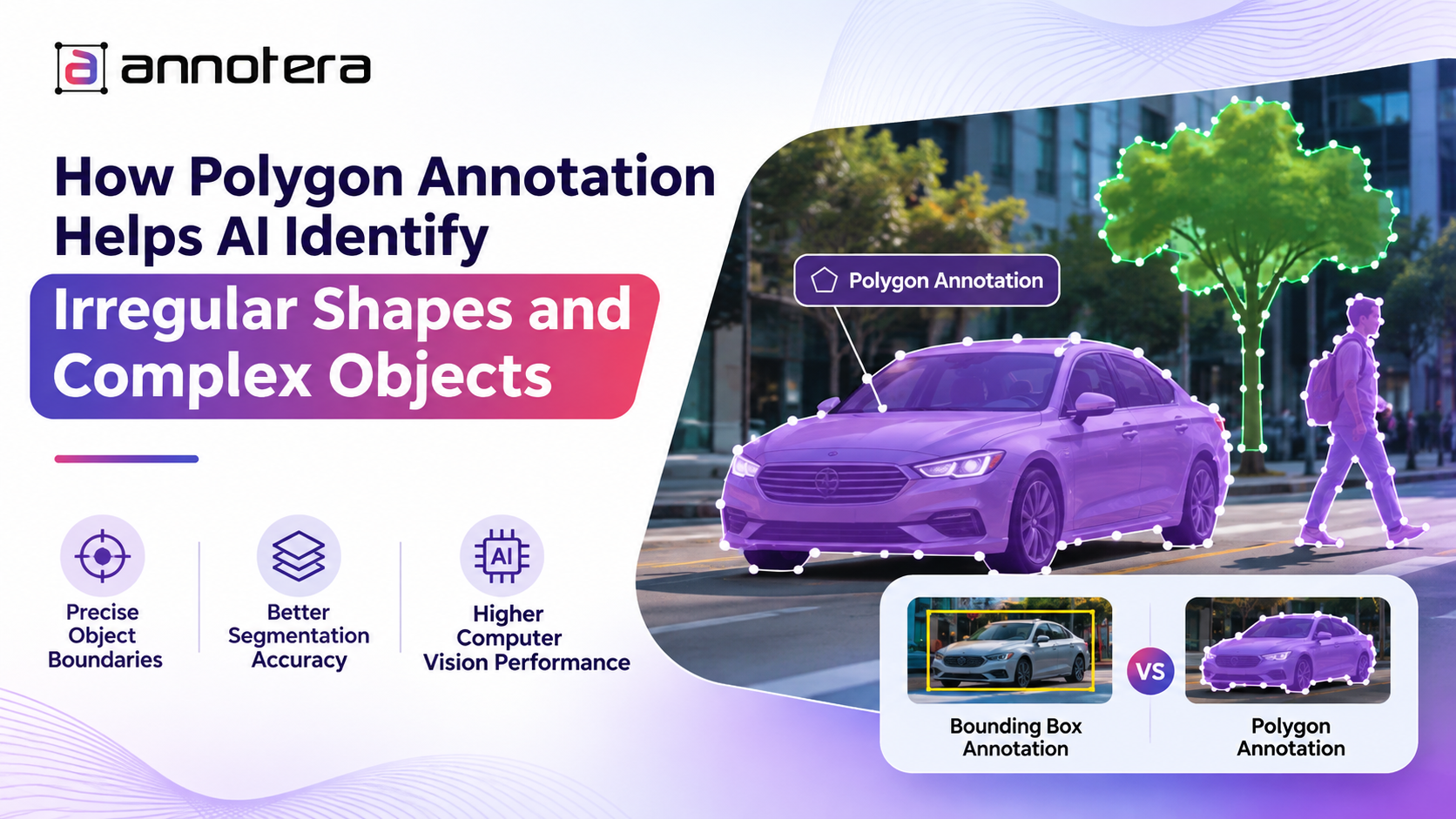
Polygon annotation is an image labeling technique used to identify objects by tracing their boundaries with multiple connected points. Unlike rectangular bounding boxes, which enclose an object within a fixed rectangular area, polygons follow the actual shape and contours of the target object.
This makes the technique particularly useful when dealing with objects that have irregular geometries, curved edges, or complex structures.
For example, consider an image containing a tree with multiple branches, a damaged vehicle, or a human figure in a dynamic position. A bounding box may include substantial background space, whereas polygon annotation can closely follow the object's visible outline.
The resulting annotations provide AI models with more detailed spatial information, supporting applications such as:
-
Semantic and instance segmentation.
-
Complex object detection and recognition.
-
Autonomous vehicle perception.
-
Medical image analysis.
-
Industrial inspection and defect identification.
-
Robotics and intelligent automation.
By capturing object boundaries more accurately, polygon labeling helps create structured datasets for advanced computer vision applications.
2. Why AI Struggles to Identify Irregular Shapes and Complex Objects
Computer vision models depend heavily on the quality and consistency of their training datasets. When objects have unusual shapes or complicated boundaries, conventional annotation methods may not provide sufficient visual detail.
Several challenges contribute to this problem.
Irregular object boundaries: Natural objects such as leaves, clouds, damaged surfaces, and vegetation rarely have perfectly defined geometric shapes. Rectangular annotations cannot accurately represent their contours.
Overlapping objects: When multiple objects appear close together or overlap, identifying individual boundaries becomes difficult. This is particularly challenging in crowded environments and complex industrial scenes.
Partial visibility: Objects may be partially hidden behind other objects, structures, or environmental elements. Models need sufficiently detailed annotations to learn from visible object regions.
Small and intricate details: Thin structures, narrow edges, and small components may be overlooked when using broad annotation techniques.
Visual similarities: Objects belonging to different categories may have similar colors, textures, or shapes, making accurate classification more challenging.
Polygon annotation addresses many of these challenges by enabling detailed boundary-level labeling instead of relying exclusively on rectangular object regions.
3. How Polygon Annotation Improves Object Recognition Accuracy
Polygon annotation improves the quality of visual training data by providing more precise information about object shapes, boundaries, and spatial locations.
Here are several ways it supports AI identification.
A. Capturing Complex Object Contours
Many real-world objects have uneven, curved, or asymmetrical boundaries. Polygon labeling allows annotators to place multiple points along an object's visible edges, creating a closer representation of its actual shape.
For example, in agricultural AI applications, identifying individual leaves requires capturing their irregular outlines rather than simply enclosing them in rectangular boxes.
This detailed representation helps computer vision systems learn meaningful shape characteristics.
B. Reducing Background Noise
Bounding boxes frequently contain background pixels that do not belong to the target object. This can introduce unnecessary visual information into training datasets.
Polygon annotation reduces this issue by following the object's actual boundaries more closely. As a result, segmentation models receive more precise spatial information, helping them distinguish foreground objects from surrounding environments.
C. Improving Object Separation
In crowded images, multiple objects may overlap or appear extremely close to each other. Polygon-based annotations help distinguish individual instances by outlining their respective visible regions.
This is particularly valuable for applications involving pedestrian detection, product recognition, and industrial component identification.
D. Supporting Advanced Image Segmentation
Semantic segmentation assigns categories to individual pixels, while instance segmentation distinguishes separate objects within the same category.
Accurate polygon annotations can provide the boundary-level labels required to train these models. Better-defined training masks can support more reliable segmentation, especially in visually complex environments.
4. Industry Applications of Polygon Annotation
The ability to identify irregular shapes and complex objects makes polygon annotation valuable across several industries.
Autonomous Vehicles
Self-driving systems must recognize pedestrians, vehicles, road boundaries, traffic signs, and roadside objects under changing environmental conditions. Polygon annotation helps capture the contours of irregular objects and distinguish closely positioned road users.
Medical Imaging
Medical images frequently contain complex anatomical structures, abnormal tissue regions, and irregular lesion boundaries. Polygon annotation helps specialists create detailed visual labels for AI-assisted image analysis and segmentation research.
Robotics and Automation
Robots operating in warehouses, manufacturing facilities, and dynamic environments must identify objects with different shapes and dimensions. Polygon-based labeling helps train perception models to recognize object boundaries and support accurate grasping and manipulation.
Retail and E-commerce
Retail AI applications use computer vision to identify products, monitor shelves, and analyze merchandise placement. Polygon annotation can help distinguish products with unusual packaging, overlapping arrangements, and complex outlines.
Agriculture
Agricultural AI systems analyze crops, leaves, fruits, and plant diseases. Since these objects often have irregular shapes, polygon labeling supports more detailed image segmentation and visual analysis.
5. Best Practices for High-Quality Polygon Annotation
The effectiveness of polygon annotation depends on how consistently and accurately datasets are labeled. Businesses should establish structured annotation guidelines to maintain quality across large-scale projects.
Some important practices include:
-
Define clear annotation guidelines: Establish consistent rules for identifying object boundaries, handling occlusion, and placing polygon vertices.
-
Use appropriate vertex placement: Add sufficient points to capture complex contours without creating unnecessarily complicated polygons.
-
Maintain category consistency: Ensure that similar objects receive consistent labels across different images and datasets.
-
Implement quality assurance: Review annotations regularly to identify missing regions, incorrect boundaries, and overlapping labels.
-
Handle partially visible objects carefully: Establish clear guidelines for annotating visible portions of occluded objects.
-
Use expert human review: Human annotators should validate machine-assisted labels, particularly when working with complex or high-precision datasets.
Combining trained annotators, standardized workflows, and quality checks helps organizations develop reliable computer vision training datasets.
6. Why Businesses Need Professional Annotation Services
As AI applications become more sophisticated, businesses require training datasets that accurately represent real-world visual complexity. Managing large annotation projects internally can create challenges involving workforce scalability, labeling consistency, project timelines, and quality control.
Partnering with a professional video annotation company can help organizations access trained annotation teams, structured workflows, and quality assurance processes.
Annotera supports businesses developing computer vision and AI applications through image annotation, video annotation, and other data labeling solutions. Its annotation capabilities help organizations prepare structured training datasets for applications involving autonomous vehicles, robotics, retail analytics, and intelligent automation.
By combining human expertise with systematic quality validation, Annotera helps AI teams build datasets that better represent complex visual environments.
Conclusion
Polygon annotation is an essential technique for training AI systems to recognize irregular shapes, complex objects, and detailed visual boundaries. By providing more precise object representations than traditional bounding boxes, it supports advanced segmentation, object recognition, and computer vision applications across multiple industries.
However, achieving reliable results requires more than simply outlining objects. Consistent annotation guidelines, accurate vertex placement, and effective quality assurance are equally important.
As organizations continue to develop increasingly sophisticated AI systems, investing in high-quality annotation workflows becomes critical. With professional annotation support from Annotera, businesses can prepare structured visual datasets that help computer vision models interpret complex real-world environments more effectively.
Ready to improve your AI training data? Partner with Annotera for scalable image and video annotation solutions designed to support your computer vision development goals. Explore Annotera's annotation services and discover how high-quality labeled data can strengthen your AI initiatives.


