
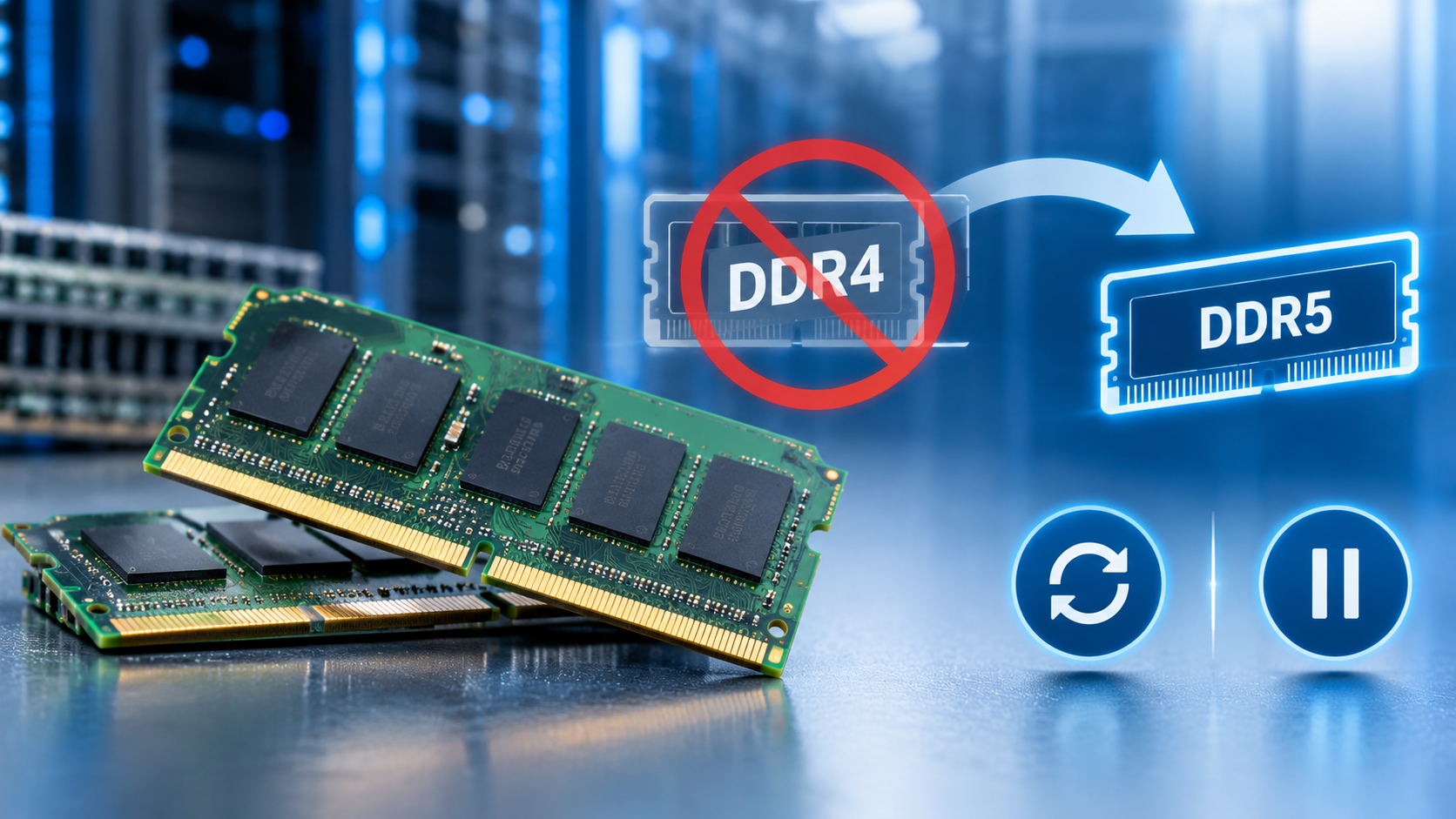
Stock Up or Start Over? A Product Manager's Guide to the DDR4 Phase-Out

Every product manager in industrial electronics knows the moment: purchasing reports that a key component is getting scarce, engineering says a redesign would take months, and sales has just promised delivery dates to a major customer. In 2026, the component causing this moment is often DDR4 memory.
DDR4 has been the standard memory in industrial PCs, controllers and embedded systems for years. Now memory makers are moving their capacity to newer memory types for AI data centres, and DDR4 is being phased out. The question on the table is a business decision as much as a technical one: stock up, or start over?
Three questions that frame the decision
Before discussing technology, answer three questions about the product itself:
1. How long will we still sell this product? A product with two years left needs a very different strategy from one with eight years ahead.
2. How many units do we need per year? Low volumes can often be covered by stock. High volumes rarely can.
3. What does a change cost us beyond engineering? Requalification, certification, customer approvals, documentation and service all count.
These three answers usually point clearly in one direction.
Option 1: Stock up and hold on
Stocking up means securing enough DDR4 to cover the remaining life of the product, or at least a long bridge period.
Works well when the product is in its final years, volumes are predictable and a change would trigger expensive requalification.
Watch out for tied-up capital, storage conditions, forecast errors and the temptation to buy from unverified brokers when the market gets tight. Stocking is a decision that needs a firm order and a budget, not a hopeful forecast.
Option 2: Start over with a redesign
Moving away from DDR4 usually means moving to a new processor platform, because the processor decides which memory type is supported. That makes it a real development project, with layout, software and testing.
Works well when the product has many years ahead, volumes are high, or the platform is ageing anyway.
The upside is often underestimated: a redesign can extend the product's life by years, add performance, address new security requirements and remove other components that are close to end of life.
Option 3: The hybrid path most teams choose
In practice, many companies combine both: they secure enough DDR4 for two to three years of production and start a redesign in parallel. This keeps deliveries running while the successor platform is developed and qualified without time pressure.
The key is to start the redesign early enough. A rushed redesign under supply pressure is more expensive and riskier than a planned one.
What to ask your engineering team this week
• Which of our products use DDR4, and which exact part numbers?
• Is the memory soldered or socketed?
• Do we have a qualified second source for each memory part?
• How long would a platform redesign take for our most important product?
• Which approvals or customer releases would a change affect?
The answers give you the basis for a decision that purchasing, engineering and sales can stand behind.
The bigger picture
The DDR4 phase-out is part of a larger memory shortage driven by AI demand. Market observers expect tight supply well into 2027, and some see no real relief before 2028. Waiting for prices to fall is therefore not a strategy.
If you want to understand the full picture, including which memory types are affected and which measures help, read this overview of how the DRAM and NAND shortage affects industrial PCs. For teams that need support with a redesign or second-source qualification, specialised electronics engineering services can shorten the path considerably.
About this article
This article is based on experience from industrial electronics projects and current market reports. It provides general guidance and does not replace a product-specific analysis.
Read More: https://tecsysproductguides.blogspot.com/2026/11/ddr4-is-being-phased-out-when-to.html


