
Is Repetitive Work Slowing Your Team? What AI Automation Services Fix

Ask any operations or marketing manager where their week goes and the answer is often the same: copying data between tools, sorting enquiries, writing the same replies and assembling reports. None of it is strategic, yet it eats hours that should go into customers and growth. This is the gap that AI automation services are designed to close.
Below, we break down why repetitive work keeps growing, what it quietly costs, and how a careful AI automation approach removes it without creating new risks.
The problem: skilled people doing robotic work
In most growing companies, talented people spend a large part of their day on tasks a well-designed system could handle. A sales coordinator reads every inbound email to decide who should answer it. A marketer rewrites product descriptions for each channel. An analyst exports data from four platforms every Monday to build the same report.
Each task feels small, so nobody prioritises fixing it. Added together, they slow response times, cause errors and leave teams feeling busy without moving the business forward.
Causes: why manual work keeps multiplying
Repetitive work rarely appears by design. It accumulates as the business grows.
-
Tool sprawl. Each new platform solves one problem but adds another place where data must be copied.
-
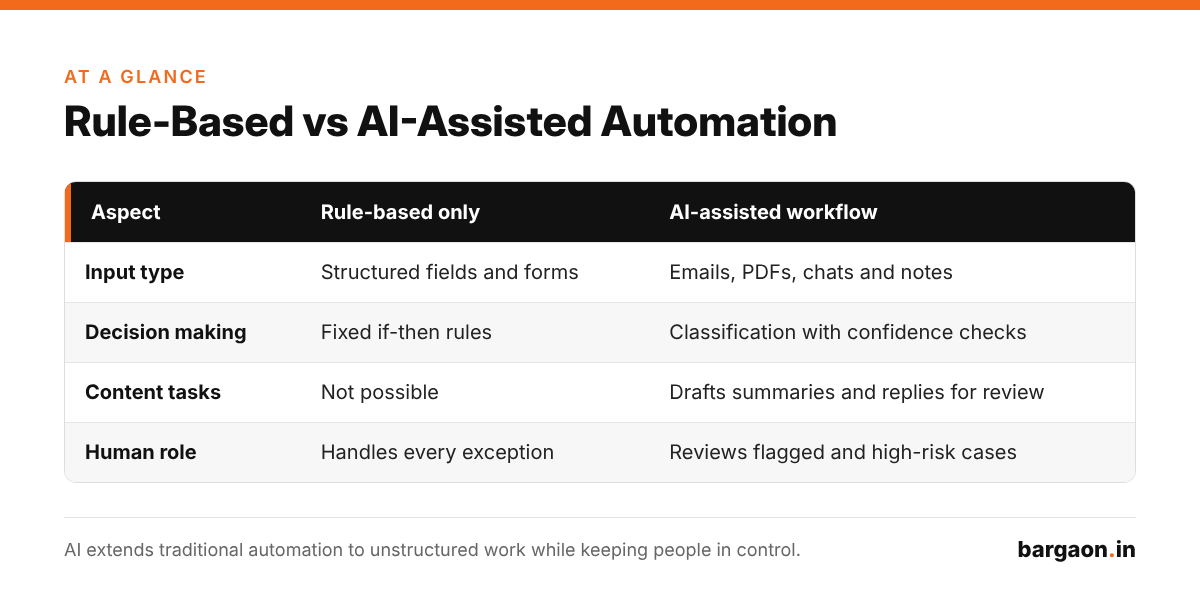
Unstructured inputs. Emails, PDFs, chat messages and call notes do not fit neatly into traditional rule-based automation.
-
Growth outpacing process. Workarounds that worked at ten customers break at a few hundred.
-
Lack of technical capacity. Teams know what they want automated but have no one to build it.
-
Uncertainty about AI. Leaders are interested but unsure where it is safe and useful to apply.
Impact: the hidden cost of repetitive tasks
The most direct cost is time. Hours spent on manual sorting and copying are hours not spent on selling, serving customers or improving products. As volume grows, companies often respond by hiring more people to do the same repetitive work, which raises costs without raising capability.
Quality suffers as well. Manual steps introduce typos, missed enquiries and inconsistent replies. Customers notice slow or uneven responses. Employees notice too, and talented people rarely stay long in roles that feel like data entry.
There is also a decision cost. When reports arrive late or depend on one person's spreadsheet, managers make calls on old or incomplete information. Problems such as a drop in enquiry quality or a backlog in support are spotted days later than they should be, by which point fixing them takes far more effort.
The solution: practical AI automation services
Modern AI models are good at the very tasks that used to resist automation: reading unstructured text, classifying requests, extracting details from documents, summarising conversations and drafting first responses. Combined with workflow tools such as Make, Zapier or n8n and your CRM, they can handle large parts of routine work end to end.
The value of professional AI automation services lies in choosing the right tasks, designing safe workflows and keeping people in control where judgement matters. The goal is AI workflow automation for business that is reliable, auditable and easy for your team to trust, not an impressive demo that breaks in week two.
Workflow: from task list to running automation
A disciplined process keeps projects focused on measurable outcomes.
-
Task inventory: list repetitive tasks with rough volume, effort and error rates.
-
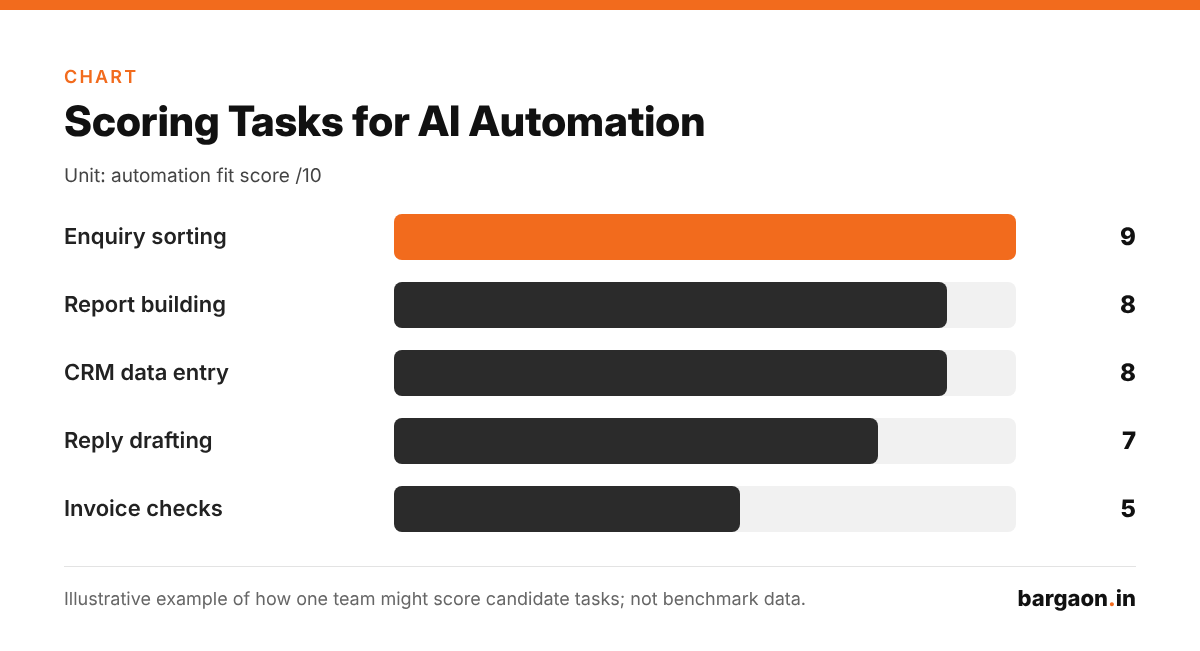
Prioritise: score each task on time saved, risk and ease of automation, then pick a first candidate.
-
Design: map inputs, AI steps, business rules and points where a human reviews output.
-
Build: connect the AI model, workflow tool and business systems, with logging for every run.
-
Pilot: run alongside the manual process, compare results and tune prompts and rules.
-
Scale: roll out fully, monitor quality and move to the next task on the list.
Benefits: faster responses and happier teams
Once routine work is automated, response times drop because enquiries are classified and routed the moment they arrive. Reports appear on schedule without anyone exporting spreadsheets. Customer-facing content stays consistent because drafts follow a shared style and are checked before sending.
Teams feel the difference quickly. People spend more time on conversations, analysis and creative work, and less on copying and pasting. Because each workflow is logged and reviewed, leaders also gain visibility into how work actually flows through the business, which makes future improvements easier to spot.
Just as important, growth stops requiring a matching increase in headcount for routine tasks.
Find the first task worth automating
The best starting point is usually one high-volume, low-risk task that frustrates your team every week. Automating it well builds confidence and creates a template for everything that follows.
Bargaon helps startups, SMBs, D2C brands and B2B companies identify those opportunities and build dependable AI workflows around existing tools. Take a look at the AI Automation page to see typical use cases and how projects are scoped.


