
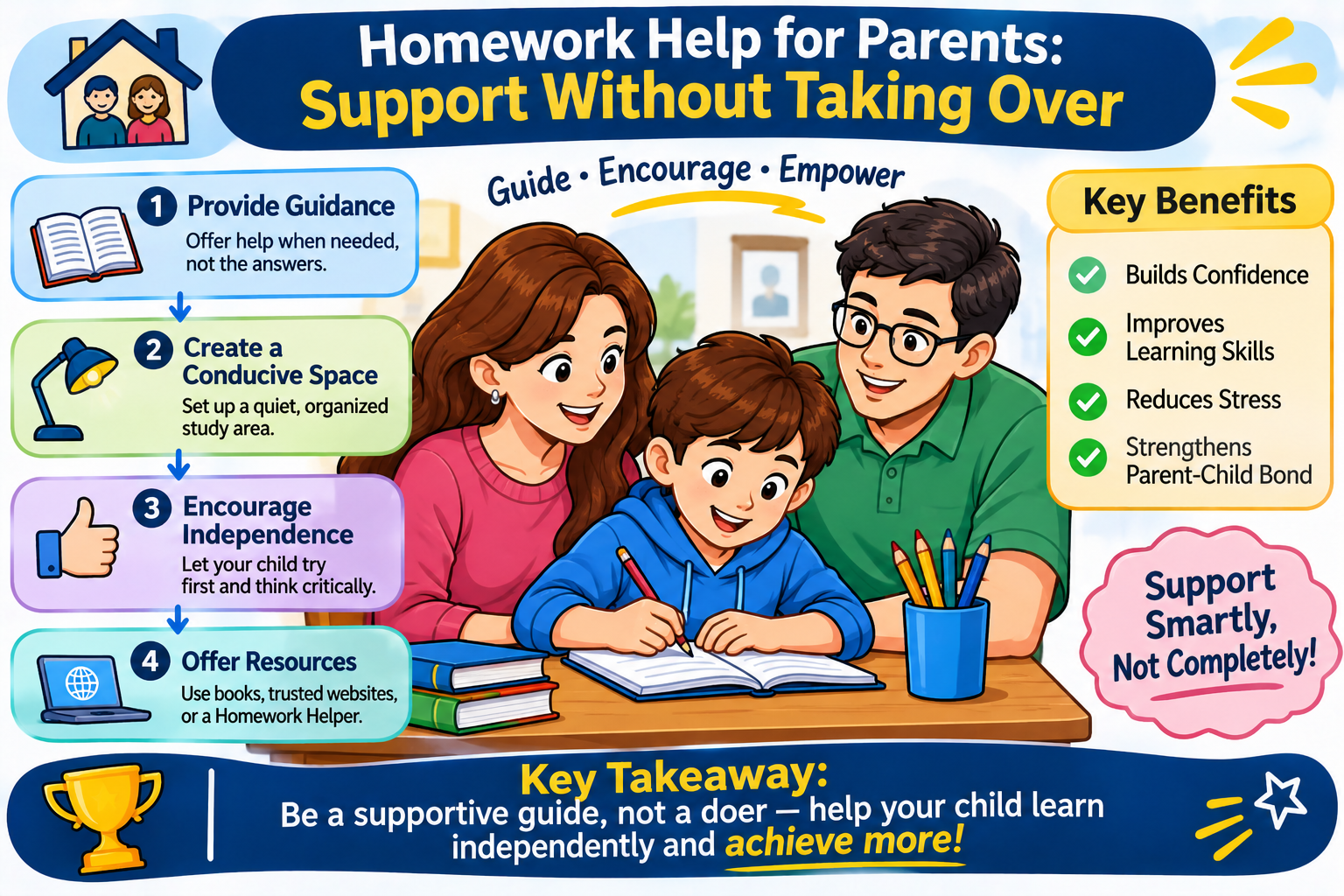

Homework time can feel like the hardest hour of the day. Your child is tired, you are tired, and a worksheet sits between you like a small wall. Many parents wonder how much to do. Step in too much and the child learns nothing. Step back too far and frustration wins. The answer sits between the two. Good homework help from a parent means guiding the thinking, not supplying the answers. This post offers practical ways to do exactly that, whatever your child's age or subject.
What Your Role Actually Is
Think of yourself as a coach, not a player. A coach sets up the field, asks good questions, and cheers progress. A player does the work. When parents slip into the player role, children often learn that waiting for rescue works. When parents hold the coach role, children learn that they can work things out, and that confidence carries into school far beyond one night's task.
Your coaching can be simple. Make sure the space is ready, the tools are at hand, and the plan for the evening is clear. Then stay available without hovering. Children can feel the difference between a parent who is nearby and a parent who is watching every pencil stroke.
Questions That Guide Without Giving the Answer
Keep a few questions ready, and use them in place of answers:
- "What is the question asking you to do?"
- "What do you already know about this?"
- "Where did you get stuck, exactly?"
- "Can you show me the last step that felt right?"
- "What would you try first if you had to guess?"
- "How could you check your answer?"
These questions slow the moment down. They also teach children how to talk themselves through problems, which is the real skill behind every subject.
Set Up the Evening
A predictable setup removes many arguments before they start. Try these habits:
- Pick the same start time most days, ideally after a snack and a short break
- Clear one table of everything except homework materials
- Keep phones and tablets in another room unless the task needs them
- Write the evening's tasks on a small list and tick them off
- Start with the hardest task while energy is highest
- Stop at a set time, even if a task is unfinished, and tell the teacher
When Your Child Is Really Stuck
Every child gets stuck, and being stuck is part of learning. Start with a reset. Suggest a two-minute break, a drink of water, or a quick walk around the garden. Then ask your child to explain the problem in their own words, as if telling a friend. Check the class notes or textbook for a similar example.
If fifteen minutes pass with no progress, stop. Ask your child to write a short note for the teacher, such as "I tried this and this, and I am stuck at this step." That note shows effort, and it tells the teacher exactly where to help. Sometimes the best homework help you can offer is permission to stop and ask.
Handling Frustration and Tears
Big feelings are common at homework time, especially after a long school day. Name the feeling first: "This looks really annoying." That small step often calms a child faster than any explanation. Then offer a short break with movement, such as jumping jacks or stretching.
Use the word "yet" often. "You have not figured this out yet" tells a child that the skill is still growing. It replaces the idea of being bad at something with the idea of being on the way, and that shift lowers the pressure for everyone in the room.
Working With the School
Parents and teachers want the same thing, so keep the channel open:
- Read the homework policy so you know how much time is expected
- Tell the teacher if tasks regularly take far longer than suggested
- Ask what the teacher wants to see: effort, accuracy, or both
- Share any learning needs or health concerns early
- Attend parent meetings with one or two specific questions
Praise That Builds Resilience
How you praise matters. "You are so smart" can make children afraid to try hard things, because a mistake feels like proof they are not. Praise effort and strategy instead. "I liked how you tried a new method when the first one failed" tells a child exactly which behaviour to repeat. Over months, this kind of feedback builds students who persist when work gets difficult.
Conclusion
Parents do not need to be experts in every subject to be useful at homework time. They need patience, a few good questions, and a calm routine. Guide the thinking, protect the space, and let your child own the work. Remember that the best homework help leaves a child more capable than before, not more dependent. Keep the coaching steady, celebrate small wins, and the evenings will get easier. Your calm support is what turns homework help into real learning.


