

A weak SaaS marketing strategy rarely fails loudly. Traffic grows, the team stays busy, and dashboards look healthy. Yet trials do not convert, sales complains about lead quality, and churn eats into every new month of revenue.
The cause is usually a handful of avoidable mistakes in how marketing is planned and measured. Below are six we see often, with a practical fix for each.
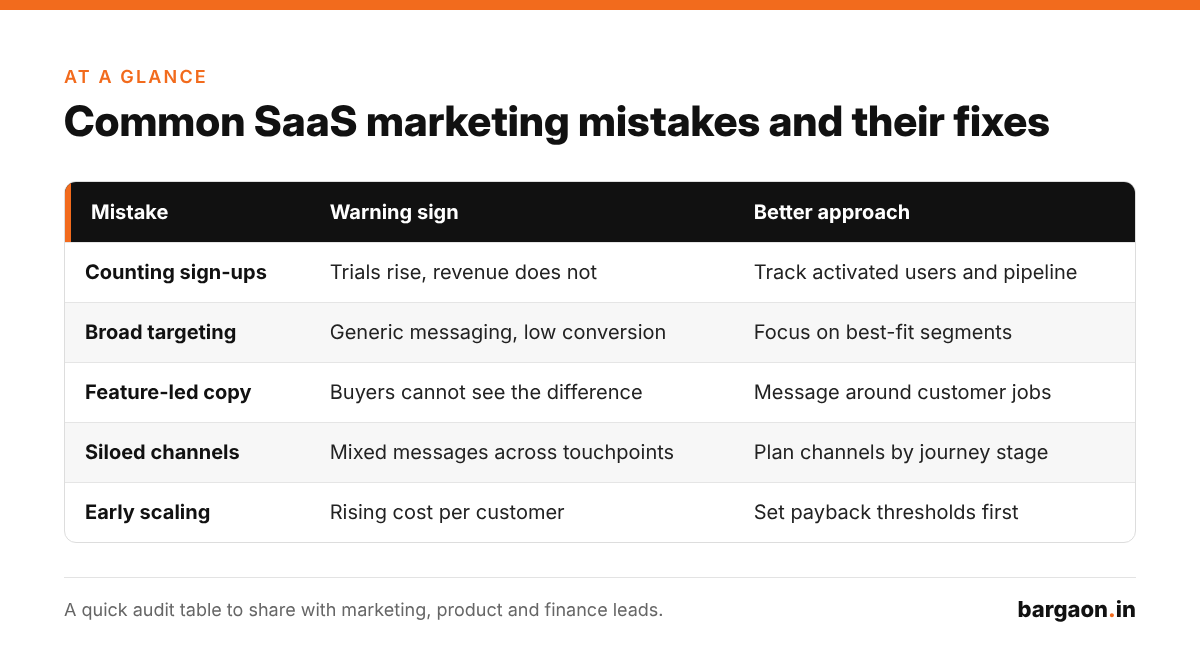
Use the list as a quick audit. If three or more sound familiar, your plan needs a rethink, not more budget.
1. Measuring sign-ups instead of activated users
Sign-ups are easy to count and easy to inflate. A campaign that doubles free trials but brings in users who never use the product adds cost, not growth.
Shift the main marketing metric to activated users or qualified pipeline. This one change forces better targeting and closer work with the product team. It is also the foundation of a sound SaaS marketing strategy, because it ties marketing to revenue rather than volume.
Agree the definition of an activated user with product and sales before the quarter starts. When everyone reports the same number, debates about lead quality become shorter and far more useful.
2. Targeting everyone who might use the product
Many SaaS tools can technically serve dozens of industries. Marketing to all of them spreads budget thin and makes messaging generic.
Pick the segments where customers stay longest and expand most. Speak to their specific problem in their language. You can always widen the focus once you own a niche.
A good test is to look at your last twenty closed deals and your last twenty churned accounts. The patterns that separate them usually point clearly to the segments worth prioritising, and those that are quietly costing you money.
3. Writing messaging around features, not jobs
Buyers do not wake up wanting a dashboard or an integration. They want to close the books faster, reduce errors, or stop chasing approvals. Feature lists make every product sound the same.
The Jobs to Be Done theory from the Christensen Institute is a useful lens here. Interview recent customers about what they were trying to get done when they started looking, and build messaging from their words.
Pay attention to what they were using before, what pushed them to switch, and what nearly stopped them buying. Those three answers often produce sharper headlines than any internal brainstorm.
4. Treating the website as a brochure
For most SaaS companies, the website is the main sales tool. Yet pricing pages are vague, demo forms are long, and visitors cannot quickly tell whether the product fits them.
Review key pages through the eyes of a first-time buyer. Usability research collected by the Nielsen Norman Group offers clear, tested principles for navigation, forms and page clarity.
Quick checks worth running:
-
Can a visitor tell who the product is for within five seconds?
-
Is pricing, or at least a pricing approach, easy to find?
-
Does every key page have one clear next step?
-
Are proof points such as case studies close to the call to action?
-
Does the page load quickly and work well on a phone?
5. Running channels in isolation
Paid search, content, email and social are often run by different people with different targets. The result is mixed messages and wasted spend on audiences that another channel already reached.
Plan channels around the customer journey instead. Decide which channel introduces the problem, which builds trust, and which converts, and share one calendar and one set of goals across them. This is where SaaS customer acquisition becomes efficient rather than just busy.
Remember existing customers in this plan too. Product updates, usage tips and upgrade campaigns support retention and expansion, and they make every acquisition rupee go further.
6. Scaling spend before the economics work
When a channel shows early promise, it is tempting to pour money in. If acquisition cost is high and payback is slow, scaling only grows the loss.
Set clear thresholds for cost per activated user and payback period before increasing budget. Treat each scale-up as a test with a review date, not a permanent commitment.
Watch for diminishing returns as budgets grow. The first slice of spend in a channel often reaches the most interested buyers, and later slices cost more for weaker results. Regular reviews catch this before it becomes expensive.
Turning the fixes into a better SaaS marketing strategy
Each of these mistakes comes from the same root: marketing planned apart from activation, retention and economics. Fixing them means building one connected plan that every team can see and measure against.
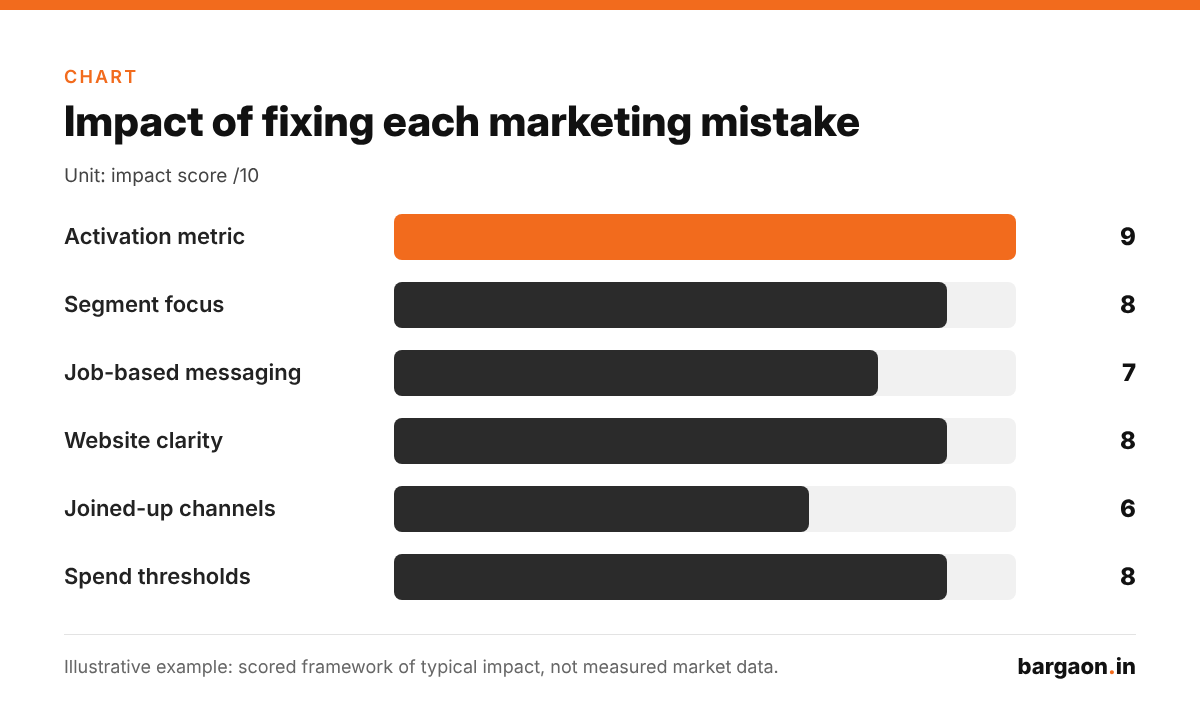
Start with the mistake that costs the most today rather than trying to fix everything at once. For most teams, changing the core metric from sign-ups to activated users unlocks the other fixes, because it changes what everyone pays attention to.
Review progress monthly with product and finance in the room, so marketing decisions are made with the full picture of activation, retention and cost.
If you want the full framework behind this, including how to link each funnel stage to targets and owners, the Bargaon guide on SaaS growth goes deeper and is worth reading before your next planning cycle.


