
Computer Tuition in Palta for CBSE: How to Pick the Right Institute

Does your child follow computer science lessons in school but freeze when asked to write a program alone? Many CBSE students in Palta reach this point in Class 11, when Python moves from simple statements to loops, functions and file handling. Searching for computer tuition in Palta for CBSE brings up plenty of advertisements, but the real question is narrower: which institute will help your child understand the subject, practice it independently and perform well in both theory and practical examinations?
The CBSE Computer Science syllabus for 2026–27 allocates 70 marks to theory and 30 marks to practical assessment. That split matters. A student who memorizes definitions may handle the written paper, but the practical component rewards those who can write, run, test and explain a program. Choosing a tutor therefore means looking beyond convenience and checking whether the teaching matches what the examination actually demands.
Families searching for computer science coaching near Palta, or for computer tuition in Ichapore, face a similar challenge. Several institutes may be a short journey away, yet distance says little about quality. This guide explains how to compare options, what good CBSE teaching looks like and how to plan the next step with confidence.
Start With the Syllabus, Not the Advertisement
Before comparing institutes, gather the official syllabus for your child's class and subject. CBSE Computer Science is subject code 083, which is different from Informatics Practices and Information Technology. Some centers use the phrase "computer classes" for all three, and this can leave students preparing for the wrong paper. Ask exactly which subject the institute teaches and which curriculum its lessons follow.
Class 11 concentrates on Python fundamentals, while Class 12 extends into functions, file handling, stacks, computer networks and database connectivity. A tutor who understands this progression can arrange lessons in a sensible order. Ask for a topic plan that shows each unit, the number of sessions allocated to it and the practical tasks students will complete. If the plan is vague, the coaching itself may be vague too.
"A student who can explain why a program works has learned more than a student who can only repeat the program they were shown."
A short self-assessment helps as well. Give your child three simple tasks: explain what a variable is, write a loop that counts values in a list, and find the error in a short program with a missing colon. The results show whether the student needs foundation work or is ready for harder problems. Share these results with the institute before enrolling, because a good tutor begins from where the student actually stands. The official CBSE Academic website is a reliable place to confirm the current syllabus and examination pattern.
What Should Good CBSE Teaching in Palta Look Like?
Effective CBSE coaching combines explanation, guided practice and independent problem-solving. A lesson should not end when the teacher finishes a demonstration. It should continue until the student can adapt the idea to a new question.
The strongest lessons follow a clear sequence. The teacher introduces the concept with a short example and traces how the program runs step by step. The student then writes a related solution, tests it with different inputs and reviews any errors. Finally, the student revises the approach and explains the reasoning in their own words. This sequence builds understanding rather than dependence on copied code.
Consider a loop. A student who can reproduce a multiplication-table program has learned one pattern. A student who can modify that loop to count even numbers in a list, or to find the largest value entered by the user, has learned the underlying idea. Ask prospective teachers to show how they would move a student from the first kind of task to the second.
Practical preparation deserves equal attention. Ask whether students write answers by hand as well as running code on a computer. Written papers test explanation, while practical work tests implementation and debugging. Each reveals different gaps, and each needs its own practice. Class 12 students should also be able to explain their practical file programs when asked, since that understanding separates memorized work from genuine learning.
For self-study between classes, the official Python tutorial offers clear, free examples that students can work through alongside their coaching. A good tutor will often recommend exercises like these and check that the student has attempted them independently.
|
Teaching element |
Strong sign |
Weak sign |
|---|---|---|
|
Concept explanation |
Teacher links the idea to a short example |
Long notes are dictated without discussion |
|
Code practice |
Students write and run programs individually |
Teacher types while students watch |
|
Error review |
Mistakes are classified as concept, syntax or logic |
Corrected code is handed over without explanation |
|
Theory preparation |
Students answer past-style questions in writing |
Only last-minute revision sheets are used |
|
Progress reports |
Parents receive specific examples of improvement |
Feedback is limited to attendance |
Questions to Ask Before You Enroll
Ask how many students share each batch, because individual attention becomes harder as numbers grow. Ask who reviews each student's code and how quickly feedback arrives. A tutor who checks work weekly can identify patterns that a rushed monthly test might miss. Ask whether there are arrangements for doubts between classes, and whether those arrangements are defined or left informal.
Ask what students solve on their own. Exercises that go beyond textbook examples reveal whether learning is actually taking place. Request samples of the tests the institute uses and check whether they resemble the CBSE theory and practical formats. Finally, ask how a missed class is handled. Families balancing school, homework and activities need a clear catch-up policy rather than a vague promise to adjust later.
Request a demonstration using a topic your child finds difficult. Watch whether the teacher checks prior knowledge, asks the student to attempt a problem and responds thoughtfully to mistakes. A polished presentation alone does not prove that learning happens, but a teacher who engages with the student's reasoning usually shows the qualities you are looking for.
Comparing Fees, Batch Timings and Travel
Fees should be compared on coverage rather than headline price. Ask what the quoted amount includes: class sessions, study material, mock tests, practical sessions and any separate charge for doubt support. Request written terms and confirm the payment schedule before committing. A lower fee that excludes practical preparation may cost more over time if your child needs extra help later.
Travel time deserves the same scrutiny. Check the route from home at the actual class time, including the journey back after evening sessions. A center that is a little further away but offers better timings and less rushed travel may serve your child better than a closer one with an awkward schedule. Include the time needed for home practice, because consistent short sessions usually produce better results than occasional long ones.
"Consistency beats intensity: thirty focused minutes on most days will carry a student further than a single long session before a test."
Be cautious about promises of guaranteed marks or rankings. Responsible coaching can commit to clear teaching arrangements, regular assessment and honest progress reports. It cannot control examination outcomes, and a tutor who claims otherwise deserves careful questioning.
Measuring Progress Through the Academic Year
Progress should be visible in what the student can do independently, not merely in attendance or the number of chapters completed. Begin with a baseline assessment, then agree on two or three measurable goals. A Class 12 student might aim to write a file-handling program without prompts, or to explain a stack operation with a diagram and a worked example.
Review progress monthly. Look for tasks that once required help and can now be completed alone. Keep an error notebook that records each problem, the mistake made and the corrected reasoning. Revisiting these entries before tests helps students avoid repeating the same errors. A sample first-month plan might look like this:
|
Stage |
Suggested activity |
What to review |
|---|---|---|
|
Starting assessment |
Short theory and coding task |
Conceptual and practical gaps |
|
Foundation work |
Revisit the weakest prerequisite topic |
Ability to explain the logic |
|
Guided application |
Related tasks with limited hints |
Reduced need for prompts |
|
Independent practice |
Unfamiliar questions under timed conditions |
Accuracy and testing habits |
This is a planning example, not a promised timetable. Students starting from different points will need different amounts of time.
Parents can ask one useful question each week: "What can you solve now that you could not solve last week?" The answer usually reveals more than a test score. If your child cannot answer it, the approach may need adjusting, the targets may need to be smaller, or extra practice on a prerequisite topic may be necessary.
How Xtech Institute Fits into Your Search
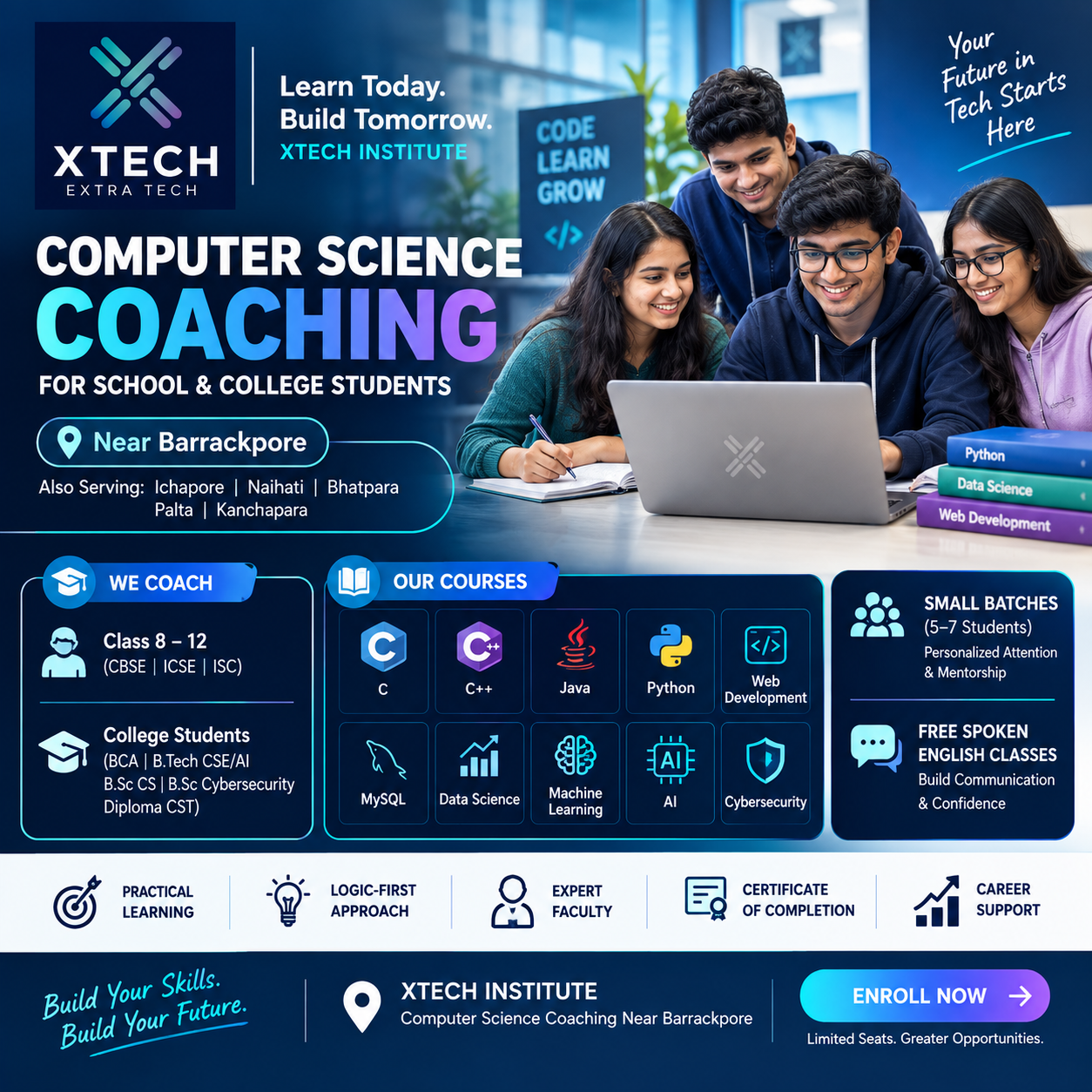
Xtech Institute – Computer Science Coaching offers academic programming support for students in Palta, Ichapore and Barrackpore. Its published course information describes support for CBSE and ICSE students as well as college courses, with hands-on programming and mentorship from founder Rajdeep Ghosh. Parents comparing options should still verify the current batch details, subject coverage and fees directly with the institute, since these can change.
When you make contact, be specific. Mention your child's class, the subject code, the topics that give trouble and the dates of upcoming tests. Ask which batch suits the current level, whether an initial assessment is available and how practical preparation is organized. The answers will show whether the institute can plan around your child rather than offering a generic course.
Bring a list of questions to the demo class, along with a recent test paper or a piece of homework your child found difficult. Looking at real work together makes the discussion concrete and shows how the teacher approaches an actual problem. Making this enquiry early also gives your child time to settle into a routine well before the next examination cycle.
Frequently Asked Questions
Is coaching necessary for every CBSE computer science student?
No. Students who understand lessons, practice regularly and resolve doubts themselves may not need additional tuition. Coaching is most useful when specific gaps persist or when structured feedback is missing.
Should a Class 11 student start with Python basics or the full syllabus?
Start with the foundations. Python fundamentals underpin later topics such as functions and file handling, so a good tutor should first confirm that the student can write and trace simple programs before moving ahead.
How early should practical preparation begin?
Begin as soon as the practical component is introduced in class. Small programs completed regularly are far more useful than intensive practice in the final weeks before the examination.
What if my child has had a poor experience with a previous tutor?
Acknowledge the experience and ask the new institute how its approach differs. Request a short trial or initial assessment so you can judge the teaching directly rather than relying on promises.
Ready to take the next step? WhatsApp Xtech Institute with your child's class, subject code and learning concerns. Ask which batch fits your child's current level and whether a demo or initial assessment is available.


