Picture spending millions on data platforms, hiring top analysts, and capturing huge amounts of data — but then making a pivotal business decision based upon gut feeling. This is the reality for many organizations. Data itself is not valuable. Structure does.
That structure is the Data Science Life Cycle. That’s the difference between a few analytics experiments and a scalable data-driven solution that affects real-world outcomes. For data science professionals leading in the age of digital transformation, knowing this life cycle is no longer a nice-to-have; instead, it’s core to creating future-ready, resilient organizations in which all data science projects result in measurable business outcomes.
Why the Data Science Life Cycle Deserves Executive Attention?
There is one fact that has to be understood before proceeding to the steps; most failures in data science occur not through wrong algorithms, but by poor alignment, lack of clarity, uncontrolled risk, and execution inadequate discipline.
The Data Science Life Cycle directly addresses these failure points.
1. Business Alignment from Day One
A structured life cycle ensures that every machine learning model exists for a business reason—not experimentation. KPIs, operational goals, and strategic priorities are connected to some of the insights generated rather than vanity metrics.
2. Risk, Ethics, and Compliance Control
Breaking a data science project into clear stages allows early identification of:
- Data privacy risks
- Regulatory exposure
- Bias and fairness concerns
This is a proactive strategy that lessens rework, legal liability, and reputation losses.
3. Higher ROI on Data Investments
In the absence of a data science life cycle, the resources are wasted on models that do not make it to production. But with the data science life cycle organised strategy guarantees:
- The resources would be used better.
- Predictable timelines.
- The quantifiable business returns.
4. Cross-Functional Execution
IT, data teams, security, and business stakeholders are naturally united by the life cycle - silos are avoided, and the deliverables are shared.
The 9 Key Steps of the Data Science Life Cycle
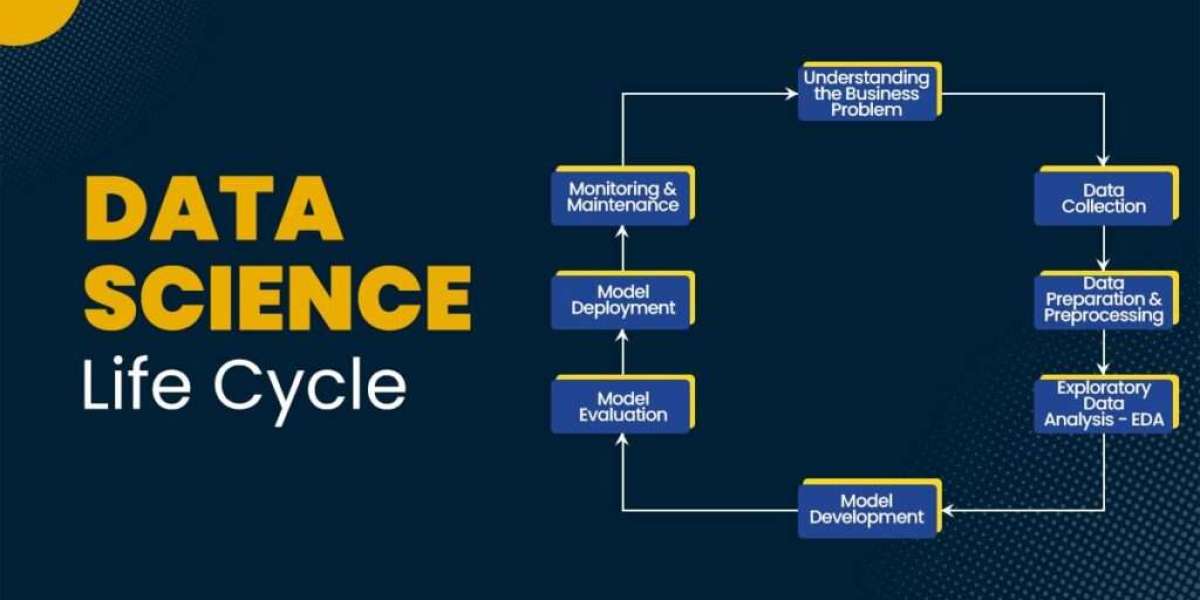
The Data Science Life Cycle is not linear—it is iterative. All the steps enhance each other, making insights dependable, moral, and viable.
1. Define the Business Problem with Precision
Every successful data science project starts with clarity. The step is aimed at transforming business pain points into analytical problems that can be solved.
Key outcomes of this stage:
- Specific business objective (what decision will be made better?
- Measures of success (how will impact be measured?).
- Limited scope (time, budget, data availability)
- Preliminary risk and ethics analysis.
Example:
To minimize losses without raising false customer alarms, identify fraudulent financial transactions in real time. This clarity eliminates any scope for issues and provides relevance in the project.
2. Acquire and Preprocess Data
When the problem is determined, the appropriate data should be collected and prepared. Incorrect data results in inaccurate models- none whatsoever.
This stage involves:
- Determining internal and external sources of data.
- Authenticating information authenticity.
- Decontaminating missing values, inconsistencies, and noise.
- Dealing with the outliers that skew the behavior of models.
Preprocessed data is the backbone of any reliable machine learning model.
3. Explore Data and Prepare for Feature Engineering
Discovery converts raw data to highly helpful data-driven insights that are driven by not assumptions.
This step focuses on:
- Analyzing patterns and relationships.
- Detecting anomalies early
- Determining variable significance.
- Plotting trends to determine the creation of features.
Raw attributes are then transformed into valuable signals to enhance the output of the model, which is a feature engineering.
4. Develop Models for Actionable Insights
In this case, data scientists choose and train models that are based on the type of problem classification, regression, or clustering.
Such critical activities are:
- Selection of algorithms as per the use case.
- Training model with prepared data.
- Optimization hyperparameter tuning.
- Performance assessment based on appropriate measures.
Complexity is not the objective, but decision-ready insight.
5. Evaluate Models for Bias and Errors
It is not sufficient to have model accuracy. This stage ensures trust.
Evaluation focuses on:
- Determining prejudice in forecasts.
- Conceptualization of false positives and falses.
- Detection of overfitting or underfitting.
- Using ROC curves and confusion matrices.
Such a step safeguards organizations against unjust, misleading, and wrong results.
6. Deploy Models into Production
Deployment involves:
- Infrastructure establishment Production.
- Business systems API integration.
- Security and access control.
- Real-time or off-line prediction procedures.
At this stage, the data-driven solution becomes operational.
7. Monitor Models for Drift and Anomalies
As data changes, the models also degrade.
Constant monitoring tracking:
- Data drift
- Prediction accuracy
- Bias re-emergence
- Performance degradation
Alerts and audits ensure models remain reliable and compliant over time.
8. Refine and Improve Models Iteratively
Models stay relevant with refinement.
Improvements may include:
- Adding new data sources
- Retuning hyperparameters
- Updating features
- Comparison of old and new performance.
This continually repeating cycle creates long-term value.
9. Align Data Science with Strategic Goals
The last step makes sure that data science is not a technical process, but a driver of business.
This includes:
- Constant stakeholder communication.
- Comparing impact to business KPIs.
- Focusing on high-value activities.
- The translation of insights into action.
Data science is a strategic value when it is aligned.
Learning the data science life cycle in detail can help you turn complex data initiatives into scalable, high-impact business capabilities. For that, you should gain deeper insight into the data science life cycle and all its phases. A globally recognized data science certification, such as USDSI® Certified Data Science Professional (CDSP™), is beginner-friendly and vendor-neutral, and the best part about this certification is that it is globally recognized across more than 160+ countries.
Conclusion: Turning Insight into Impact
The Data Science Life Cycle answers the emotional question every data science professional face: How do we turn data into decisions that matter?
Through systematic, disciplined management, consisting of defining the problem and refining it in wide-ranging cycles, organizations go beyond the experimental cycle to long-lasting impact. When executed correctly, each data science project strengthens trust, accelerates innovation, and delivers measurable value. The future of leadership is in the ability of leaders not only to gather information but also to make use of it, in the right place and in the most strategic way.
Keep exploring and upskilling in the data science concepts, such as the data science life cycle, to build a strong foundation in data science.
Frequently Asked Questions
- How long does a complete data science life cycle typically take?
It depends on the case; enterprise projects normally consume weeks to months, depending on the availability of data, complexity, and deployment needs. - Can the data science life cycle work with small or incomplete datasets?
Yes, however, smaller datasets need less complex models and more robust validation to prevent overfitting and unreliable conclusions. - Who owns the data science life cycle inside an organization?
It is owned collectively- business teams are used to set objectives, and data and engineering teams act as the execution and operationalizing force.