
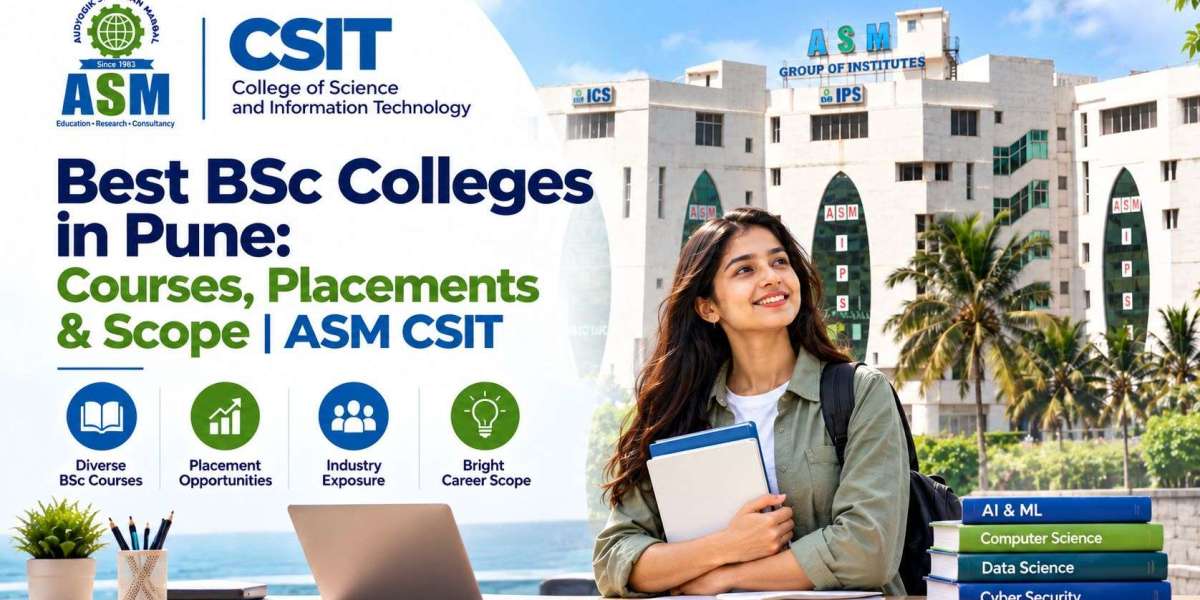
Meta Title :- Best BSc Colleges in Pune: Courses, Placements & Scope | ASM CSIT
Meta Description :- Discover top BSc career options after 12th, placement opportunities, and future-ready BSc courses at the best BSc colleges in Pune like ASM's CSIT.
BSc College in Pune: Start Your Journey Towards a Future-Ready Career
Introduction
Choosing the right undergraduate course after Class 12 can influence your academic direction and future career opportunities. For students interested in technology, computing, artificial intelligence, cybersecurity, data, and digital applications, a B.Sc. degree can provide a strong foundation for further study and professional growth.
Choosing a BSC College in Pune therefore involves more than comparing college names. Students should consider the course specialisation, curriculum, practical exposure, industry interaction, skill-development opportunities, eligibility, and career support.
ASM's CSIT offers B.Sc. programmes in Computer Science, Information Technology, Artificial Intelligence and Machine Learning, Cyber Security, and Animation. Its official programme page describes the B.Sc. programmes as three-year undergraduate courses structured across six semesters, combining theoretical learning with laboratory work, projects, and industry engagement.
This article explains what students should look for in a B.Sc. programme, the specialisations available at ASM's CSIT, potential career pathways, and the skills that can support a future-ready professional profile.
Key Takeaways
- B.Sc. programmes can build foundations in computing, programming, analytics, AI, cybersecurity, and related fields.
- ASM's CSIT offers multiple B.Sc. pathways, including Computer Science, IT, AI & ML, Cyber Security, and Animation.
- The programmes are structured as three-year undergraduate degrees across six semesters.
- Practical learning includes laboratory work, projects, and industry engagement.
- Value-added learning includes Python, Power BI, AWS Cloud Foundations, Excel, communication, and quantitative reasoning.
- Students should compare curriculum, eligibility, practical training, and career support before applying.
What Makes a B.Sc. Programme Future-Ready?
Technology is changing the skills required across industries. Artificial intelligence, cloud computing, data analytics, automation, and cybersecurity have created new areas of learning and professional specialisation.
The National Education Policy 2020 also identifies emerging areas such as artificial intelligence, machine learning, and big data analysis as important areas for higher education and employability.
A relevant B.Sc. programme can combine:
- Strong academic fundamentals
- Laboratory and practical learning
- Programming and analytical skills
- Project-based learning
- Emerging technology exposure
- Communication and teamwork
- Industry-oriented training
- Additional certifications
When evaluating a BSC College in Pune, students should therefore look at how effectively the programme combines theoretical knowledge with practical application.
How to Choose the Right B.Sc. College
Before selecting a college, consider these factors:
1. Specialisations
Choose a specialisation according to your interests and career plans. Technology-focused options include:
- Computer Science
- Information Technology
- Artificial Intelligence and Machine Learning
- Cyber Security
- Animation
2. Curriculum
Check whether the curriculum covers both fundamental concepts and practical applications.
The B.Sc. Computer Science programme at ASM's CSIT includes areas such as:
- Programming
- Data structures
- Database management
- Computer networks
- Software development
- Web technologies
- Data science and analytics
- Mobile application development
The programme is a three-year, full-time degree with 240 seats and SPPU affiliation.
3. Practical Exposure
A technology-focused degree should provide opportunities to apply classroom learning.
Look for:
- Laboratory sessions
- Academic projects
- Internships
- Workshops
- Industry interactions
- Technical certifications
- Career-development activities
ASM's CSIT specifically focuses on laboratory work, real-world projects, industry engagement, and practical experience among the B.Sc. programme objectives.
Exploring the Best BSc colleges in Pune
Students searching for the Best BSc colleges in Pune should compare institutions using measurable academic and professional factors instead of relying only on rankings or promotional claims.
Check:
- University affiliation
- Programme duration
- Available specialisations
- Eligibility requirements
- Curriculum
- Laboratory facilities
- Industry exposure
- Value-added courses
- Internship opportunities
- Career and placement support
ASM's CSIT B.Sc. programmes are affiliated with Savitribai Phule Pune University and offer admission information according to applicable university rules. Students should verify current requirements before applying.
B.Sc. Specialisations at ASM's CSIT
B.Sc. Computer Science
The programme develops knowledge of programming, computing, databases, networks, software development, and related areas.
ASM's CSIT:
- Three-year duration
- 240 seats
- Full-time degree
- SPPU affiliation
The curriculum includes programming languages and subjects such as data structures, DBMS, software engineering, web technologies, data analytics, and mobile applications.
B.Sc. Artificial Intelligence and Machine Learning
AI and ML can suit students interested in programming, data, intelligent systems, and emerging technologies.
The programme covers areas such as:
- Python
- Data science
- Machine learning
- Deep learning
- Neural networks
- Natural language processing
- Big data technologies
B.Sc. Cyber Security
Cybersecurity focuses on protecting digital systems, networks, applications, and information.
Students can encounter areas such as:
- Cybersecurity fundamentals
- Network security
- Python programming
- Database management
- Linux
- Digital communication
B.Sc. Information Technology and Animation
B.Sc. IT provides another technology-focused pathway, while Animation can suit students interested in digital creativity and visual technology.
BSc career options after 12th
The BSc career options after 12th depend on the chosen specialisation, practical experience, and additional skills developed during graduation.
Potential areas include:
- Software development: Application, web, mobile, and software testing roles
- Data and analytics: Data analysis, visualisation, databases, and business analytics
- Artificial intelligence: Machine learning and AI-related entry-level roles
- Cybersecurity: Security operations, network security, and information security
- IT services: Technical support, systems, applications, and infrastructure
- Higher education: Master's programmes and specialised qualifications
Students can improve their preparation by combining academic learning with projects, internships, certifications, and technical practice.
BSc placement opportunities: What Should Students Check?
Students researching BSc placement opportunities should distinguish between placement assistance and guaranteed employment.
Before choosing a college, check:
- Companies participating in recruitment
- Internship opportunities
- Technical training
- Aptitude preparation
- Interview preparation
- Resume support
- Eligibility criteria
- Course-specific placement information
- Academic year covered by placement data
Placement information should be interpreted in context because opportunities can vary according to specialisation, student skills, employer requirements, and market conditions.
Future-ready BSc courses: Skills to Develop
Future-ready BSc courses can combine strong fundamentals with exposure to technologies and professional skills.
Students can focus on:
- Programming and computational thinking
- Data analysis and visualisation
- Cloud computing
- Cybersecurity fundamentals
- Artificial intelligence
- Communication and presentation
- Teamwork and problem-solving
ASM's CSIT includes value-added learning in areas including Data Analysis Using Python, Power BI, AWS Cloud Foundations, Microsoft Excel, professional communication, quantitative reasoning, and German language learning.
Why Consider ASM's CSIT?
For students comparing a BSC College in Pune, ASM's CSIT provides several B.Sc. pathways within one institution.
Its programme highlights are:
- Three-year undergraduate B.Sc. programmes
- Six-semester structure
- Laboratory and practical learning
- Project-based learning
- Industry engagement
- Emerging technology exposure
- Value-added certification programmes
- Communication and professional development
This range allows students to explore different academic directions, from Computer Science and IT to AI & ML, Cyber Security, and Animation.
Before You Apply
Before selecting a BSC College in Pune, create a simple checklist:
- Identify your preferred specialisation.
- Check Class 12 eligibility.
- Compare curricula.
- Verify university affiliation.
- Review practical and laboratory facilities.
- Check internship and project opportunities.
- Examine value-added certifications.
- Ask for current placement information.
- Compare fees and other expenses.
- Verify the latest admission rules from official sources.
ASM's CSIT eligibility and admission procedures follow applicable university and government norms, with 10+2 or equivalent as the basic qualifying level.
Conclusion
Choosing a B.Sc. programme is an important step for students planning careers in technology, computing, data, cybersecurity, AI, or other emerging fields. A strong undergraduate programme can provide academic knowledge while helping students develop practical and professional skills.
The right BSC College in Pune should be evaluated through its curriculum, specialisations, practical learning, industry exposure, and career-development opportunities.
For students exploring the Best BSc colleges in Pune, ASM's CSIT offers multiple technology-focused B.Sc. pathways and additional skill-development opportunities.
Students considering Future-ready BSc courses should focus on strong fundamentals while developing technical, analytical, and communication skills. Researching programmes carefully and verifying current admission information can help students make a well-informed academic choice.