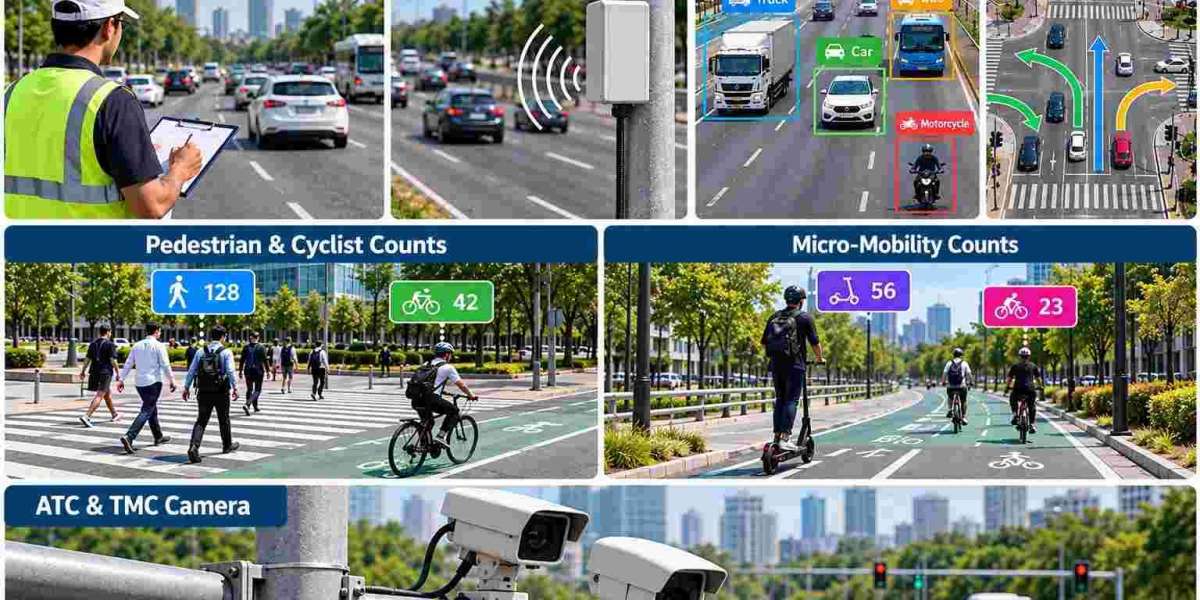
Why Industrial Sites Behave Differently from Offices and Malls
A shopping mall peaks on weekends and evenings, while a logistics hub peaks at dawn, at shift change, and whenever a vessel or flight releases a wave of cargo. Heavy vehicles are long, slow to accelerate, and need wide turning paths, so a junction that works for cars can fail quickly once trucks dominate the flow.
Industrial parks in Jebel Ali, Dubai South, Dubai Industrial City, Sharjah, and Khalifa Economic Zones in Abu Dhabi also depend on a small number of access roads, so congestion at one gate can back up traffic onto a major highway and delay many unrelated businesses.
Measuring Truck Flows with Automated Traffic Counts (ATC)
Logistics demand shifts across the week, the month, and the year. Automated Traffic Counts (ATC) record volumes continuously over many days, showing when trucks arrive, how strong the Monday surge is, and how peak season in the run up to major retail events changes the picture.
Because the record is continuous, it captures night movements and early morning waves that a short daytime count would completely miss.
Why Classified Vehicle Counts Matter Most for Freight
A total vehicle number is almost useless in an industrial study. Classified Vehicle Counts split flows into cars, pickups, vans, rigid trucks, articulated trucks, and trailers, which drives pavement thickness, lane width, turning radius, and the number of waiting bays needed at a gate.
Linking Vehicle Class to Road Wear and Noise
Heavy axle loads damage surfaces far faster than cars, so knowing the true truck share allows engineers to design pavements that last and to estimate maintenance budgets honestly. The same data supports noise and air quality assessments for nearby communities.
Junction Design with Turning Movement Counts (TMC)
Trucks turning into and out of a logistics park create the conflicts that cause crashes and queues. Turning Movement Counts (TMC) show exactly how many vehicles turn at each access junction and in which direction, so designers can choose dedicated turn lanes, longer storage, and signal phases that suit heavy vehicles.
Testing future volumes against these movements also tells a developer whether the proposed gate layout can cope with expansion or whether a second access will be needed in a few years.
Gate Queues, Truck Staging, and On-Site Circulation
Surveys should not stop at the public road. Counting arrivals at the gate, measuring how long trucks wait, and observing how vehicles move inside the yard reveals whether queues will spill back onto the street and whether loading bays are used efficiently.
A well-designed staging area, supported by evidence from counts, keeps waiting trucks off the public road, which reduces accidents and avoids complaints from neighbouring businesses and authorities.
Workers on Foot and Bicycle Within Industrial Parks
Thousands of workers reach industrial areas by bus, walk from a drop off point, or ride a bicycle from nearby accommodation. Pedestrian & Cyclist Counts measure how many people cross truck routes, when shifts change, and where informal crossing points have appeared, which supports safer crossings, shaded walkways, and protected bicycle routes.
Mixing heavy vehicles and pedestrians is a serious safety risk, so this data often becomes the strongest argument for separating the two flows.
Last Mile Scooters and Delivery Bikes
Delivery riders and short hop scooters are now common around logistics zones and labour accommodation, and Micro-Mobility counts show where these riders travel, where they mix with trucks, and where protected lanes or parking points would reduce conflict.
Equipment That Works in Heat, Dust, and Heavy Traffic
Industrial roads are harsh on equipment, so fieldwork relies on robust units such as an ATC & TMC Camera that records volumes and junction movements from a single mounting. You can explore the methods we use on our traffic survey service page, including how cameras are housed and checked during long surveys.
Video also gives a permanent record that can be reviewed later, which helps when a client or authority questions how many trucks were really counted on a particular day.
Authorities, Approvals, and Truck Movement Rules
Submissions in the UAE are reviewed by bodies such as the Roads and Transport Authority in Dubai, the Department of Municipalities and Transport in Abu Dhabi, and free zone authorities, and many emirates restrict truck movement at certain hours, which affects both arrivals and the timing of survey days.
A provider familiar with these rules can schedule counts when trucks are actually allowed to move and can present results in the format each reviewer expects, avoiding costly resubmissions.
Experience and Trust Signals for Logistics Developers
Developers should ask for completed industrial and logistics studies, trained field crews, written quality checks, and sample reports. Evidence that a provider has already worked near ports, free zones, and major freight corridors is worth more than a long list of generic equipment.
Clear documentation of survey dates, weather, and unusual events beside the counts also helps reviewers understand exactly what the numbers represent years after the survey was done.
Choosing Traffic Surveys UAE Providers for Freight Projects
When selecting Traffic Surveys UAE developers can rely on for freight projects, ask about experience with heavy vehicle classification, night and early morning coverage, equipment protection in dust and heat, and how quickly a validated dataset is delivered, since delays can hold up a lease signing or a design submission.
Dubai Logistics Corridors and Port Access
Dubai's freight network links Jebel Ali, Dubai South, Al Quoz, and Al Awir, with heavy demand on a small set of corridors, so Traffic Surveys Dubai projects for logistics sites often need several count types at once and careful timing around truck movement restrictions.
Early engagement with the authority and the landlord, agreement on survey days, and clarity on report format keep a Dubai freight project on schedule.
Warehouse Parks, Cold Chain, and Last Mile Hubs
Different logistics sites generate different patterns. A cold storage facility sees steady refrigerated trucks through the night, an ecommerce fulfilment center sends out waves of vans every morning, and a bulk warehouse park receives long haul trailers in tight windows. A survey plan should reflect the real tenant mix rather than a generic average.
Planners also need to consider future tenants, because a building designed today for storage may become a distribution center with far higher van volumes within a few years.
Reporting Results for Lenders, Tenants, and Authorities
Survey findings serve more than the traffic engineer. Lenders want proof that access risks are understood, tenants want confidence that their trucks will not queue for hours, and authorities want evidence that the project will not harm surrounding roads.
Clear tables by time interval and vehicle class, a short method note, and simple charts of peak hours let each audience find what it needs without asking for a separate report.
Conclusion
Reliable Traffic Surveys protect industrial and logistics developments from costly access mistakes, and Automated Traffic Counts (ATC) reveal the full rhythm of freight demand. Classified Vehicle Counts and Turning Movement Counts (TMC) show how trucks load pavements and stress junctions. Pedestrian & Cyclist Counts and Micro-Mobility Counts keep workers and delivery riders safe around heavy vehicles. A rugged ATC & TMC Camera keeps the evidence accurate in heat and dust. For any Traffic Surveys UAE or Traffic Surveys Dubai logistics project, contact our team today to plan your survey.
FAQs
- When should a logistics developer commission Traffic Surveys during the project?
Ideally before the site layout is fixed, so the survey can shape gate location, turn lanes, and staging areas instead of forcing expensive changes later.
- How long should Automated Traffic Counts (ATC) run at an industrial access road?
Seven days or more is recommended, with night coverage, so weekday waves, weekend activity, and early morning truck arrivals are all captured.
- Why are Classified Vehicle Counts essential for freight studies?
They separate trucks and trailers from cars and vans, which determines pavement design, turning radius, and gate capacity.
- What do Turning Movement Counts (TMC) reveal at a logistics park entrance?
They show how many trucks turn each way at the access junction, guiding turn lane length, storage space, and signal timing.
- Can an ATC & TMC Camera cope with dust and extreme heat?
Yes, properly housed and regularly cleaned cameras maintain reliable recording, and quality checks confirm the data stays consistent through the survey period.