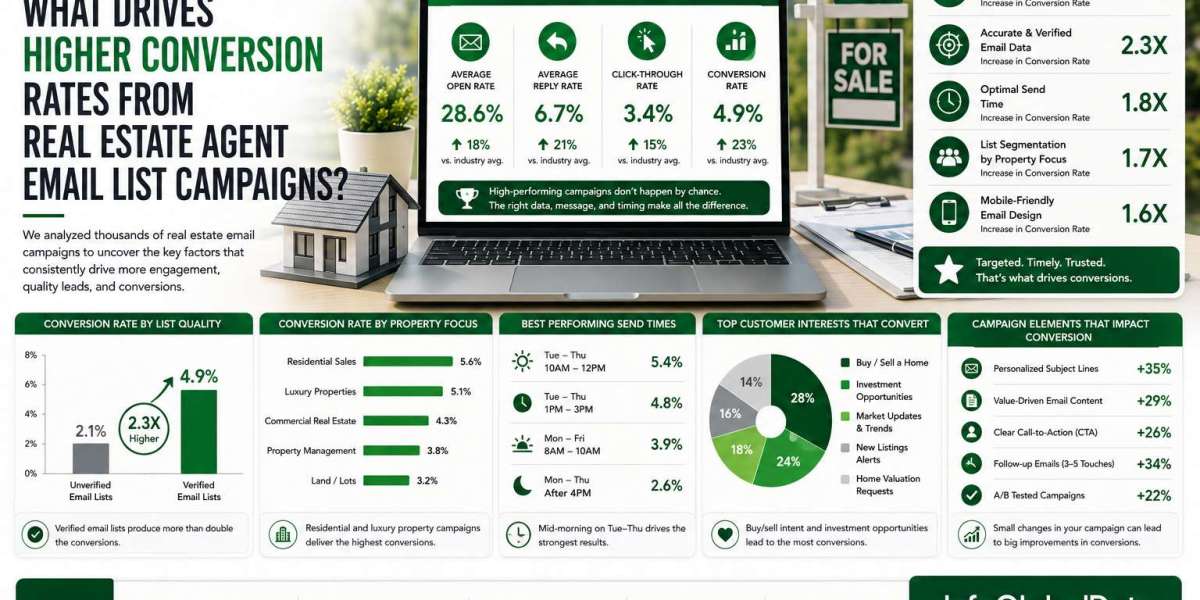
Introduction
Real estate email campaigns perform best when they are built around relevance, trust, timing, and clean contact data—not simply a large number of contacts. The latest National Association of REALTORS® (NAR) technology research found that 11% of REALTORS® identified email marketing tools as their top lead-generating technology, while CRM systems generated 23% and social media led at 39%.
That makes email a meaningful but competitive channel for reaching real estate professionals and prospects. At the same time, MailerLite's 2025 benchmark data shows that the real estate industry recorded a 6.72% click-to-open rate, providing a useful directional benchmark for engagement.
This article examines what can improve conversion from a Real Estate Agent Email List, including segmentation, personalization, data quality, relevant offers, follow-up, and measurement.
Why Real Estate Email Conversion Depends on More Than List Size
A larger database does not automatically create more opportunities.
Conversion depends on the relationship between four variables:
Audience quality × message relevance × timing × follow-up
A poorly targeted list can produce thousands of deliveries but few meaningful conversations. A smaller, well-segmented audience can generate stronger engagement because the message aligns with the recipient's role, market, or business need.
NAR's 2025 Technology Survey, based on responses from more than 1,200 agents, found that social media was the leading technology for generating quality leads at 39%, followed by CRM systems at 23% and local MLS tools at 17%. Email marketing tools ranked at 11%.
The implication is important: email should not necessarily be treated as a standalone acquisition channel. Its strongest role may be in nurturing, follow-up, relationship development, and moving prospects toward conversations.
What Does the Real Estate Email Benchmark Tell Us?
MailerLite's 2025 email benchmark analyzed more than 3.6 million campaigns from 181,000 approved accounts sent between December 2024 and November 2025. Across industries, the median click rate was 2.09% and the median click-to-open rate was 6.81%.
For real estate specifically, the reported click-to-open rate was 6.72%.
Click-to-open rate is useful because it asks a more specific question than simply whether recipients opened an email:
Of the people who opened the message, how many clicked?
For marketers evaluating a Real Estate Agent Mailing List, this distinction matters. A campaign may generate a respectable number of opens but still fail to create business outcomes if the content does not motivate action.
However, these benchmarks should be treated as directional rather than guaranteed performance targets. MailerLite's dataset covers email marketing campaigns broadly and does not represent a controlled study of cold B2B outreach to real estate agents.
1. Audience Segmentation Can Improve Relevance
One of the strongest conversion levers is segmentation.
A single Real Estate Agent Email List may contain agents with very different:
Geographic markets
Experience levels
Residential or commercial specialties
Brokerage affiliations
Team structures
Property specialties
Technology adoption
Business objectives
Sending identical messaging to every contact ignores those differences.
HubSpot's 2025 marketing research found that 94% of marketers said providing a personalized customer experience impacts sales, while only 65% reported having high-quality data about their target demographics.
The gap between personalization's perceived importance and data quality is revealing.
For real estate outreach, useful segments might include:
Residential agents
Messaging can focus on buyer/seller pipeline development, local market intelligence, referral generation, or client retention.
Commercial agents
The value proposition can shift toward property intelligence, business development, investor relationships, or commercial prospecting.
Newer agents
Campaigns may emphasize pipeline building, prospecting efficiency, CRM adoption, and repeatable lead-generation processes.
Experienced agents
Messaging can focus more heavily on referrals, repeat business, productivity, and expanding an established sphere.
Segmentation works because it changes the reason to respond, rather than merely changing the recipient's name.
2. Personalization Should Reflect Real Estate Business Priorities
Personalization is most effective when it communicates useful context.
For example, replacing "Hi John" with "Hi John, I noticed you're a residential agent in Chicago" is still relatively basic.
A stronger message could connect the recipient's market and role with a specific business challenge.
This distinction is supported by broader marketing research. HubSpot reported that 86% of marketers said their customers receive a somewhat or very personalized experience, while 94% said personalization affects sales.
For a Real Estate Agent Email Database, personalization fields can include:
Agent name
Brokerage
Market
Property specialization
Professional role
Experience level
Team size
Previous engagement
Relevant content interests
The objective should be to make the message more useful, not simply more customized.
3. Market-Specific Content Can Strengthen Conversion
Real estate is inherently local.
An agent working in a high-growth metropolitan market faces different conditions from one operating in a smaller regional market. Inventory, affordability, competition, property types, buyer profiles, and local economic conditions can all influence business priorities.
NAR's 2025 Profile of Home Buyers and Sellers reported that mortgage rates averaged 6.69% during the period covered by the report, while affordability and limited inventory continued to affect the housing market.
These market conditions create opportunities for more relevant email content.
Instead of sending:
"Improve your real estate lead generation."
A marketer could offer:
"Three prospecting strategies for agents competing in a high-rate, low-inventory market."
The second message connects the offer with an identifiable market environment.
That type of contextual relevance can make a Real Estate Agent Mailing List more valuable because segmentation determines which insight each group receives.
4. Relationship-Based Messaging Matters
Real estate is fundamentally relationship-driven.
NAR's latest member research shows that 28% of the typical REALTOR®'s business came from past clients and customers, up from 20% in the previous year's report. Among agents with more than 16 years of experience, repeat business represented roughly half of their customer pipeline.
This is a powerful signal for email strategy.
Not every campaign should attempt to generate an immediate sale or meeting.
Email can also support:
Client retention
Referral generation
Market updates
Educational content
Post-transaction communication
Re-engagement
Cross-selling
Long-term nurturing
NAR has also emphasized the importance of staying in touch after transactions, noting that nearly 90% of home buyers and sellers say they would recommend their agent.
For marketers targeting real estate professionals, this reinforces the importance of relationship-oriented messaging.
5. The Offer Must Give Recipients a Reason to Act
A good email can still fail if the CTA is weak.
Common low-friction CTAs include:
Download the market report
View the benchmark
Compare options
Get the checklist
Request the data
See the analysis
Book a short consultation
The CTA should match the recipient's stage of interest.
For a cold audience, "Buy now" or "Schedule a 60-minute demo" may create unnecessary friction.
For an engaged prospect, a meeting-oriented CTA may make more sense.
This is where a segmented Real Estate Agent Email List becomes particularly useful: different segments can receive different offers based on their likely needs and previous engagement.
6. AI Can Increase Personalization at Scale—But It Needs Good Data
AI is increasingly being incorporated into marketing workflows, including email creation and personalization.
HubSpot published a 2025 case study describing how its team redesigned a nurture program around AI and reported an 82% increase in email conversions. The company emphasized that the improvement came from moving beyond broad segmentation toward more individualized personalization and testing.
This is a company-specific case study, not a universal benchmark for real estate campaigns. It should therefore be interpreted as evidence that AI-assisted personalization can produce substantial improvements in a controlled environment—not as a guarantee of an 82% increase for every campaign.
NAR's 2025 Technology Survey also found that 46% of REALTORS® reported using AI-generated content, while 20% said they use AI daily and 22% weekly.
For marketers, the takeaway is straightforward:
Use AI to scale relevant messaging, but do not let automation replace audience research.
7. Clean Data Protects Conversion Potential
List quality is another major factor.
ZeroBounce's 2026 Email List Decay Report analyzed more than 11 billion email addresses processed during 2025 and found that at least 23% of email-list data decays within one year. More than 9% of the emails checked were catch-all addresses.
Although these are broad email-industry benchmarks rather than real-estate-specific figures, they demonstrate the speed at which professional contact data can deteriorate.
For a Real Estate Agent Email Database, regular maintenance should include:
Email verification
Job-title validation
Brokerage validation
Duplicate removal
Bounce suppression
Unsubscribe management
Periodic revalidation
Bad data can undermine every other optimization. There is little value in perfect personalization if the message is sent to an inactive or incorrect address.
8. Deliverability Is a Conversion Prerequisite
Conversion begins with inbox placement.
Validity's 2026 Email Deliverability Benchmark Report analyzes trillions of global inbox data points and reports on changes in inbox placement, mailbox-provider behavior, and industry-specific deliverability.
This reinforces an important principle:
You cannot optimize conversion from messages recipients never see.
Marketers should monitor:
Bounce rate
Spam complaints
Inbox placement
Domain reputation
Authentication
Engagement
Unsubscribe rates
List hygiene and responsible sending practices therefore belong in the conversion strategy—not only the technical deliverability strategy.
9. Measure Conversions, Not Just Opens
Open rates can be useful diagnostically, but they should not be the final KPI.
A stronger funnel looks like this:
Delivered → Engaged → Clicked → Replied → Qualified → Meeting → Opportunity → Customer
For each campaign, track:
Delivery rate
Click rate
Reply rate
Positive reply rate
Meeting-booked rate
Lead-to-opportunity rate
Conversion rate
Revenue generated
MailerLite's real estate benchmark of 6.72% click-to-open can provide contextual comparison, but internal conversion data should ultimately determine whether a campaign is successful.
5 Practical Ways to Increase Real Estate Email Conversions
1. Segment before writing
Define the audience by role, market, specialty, experience, or business model before creating the campaign.
2. Personalize around a business problem
Use relevant context rather than superficial personalization.
3. Match the CTA to intent
Cold prospects need lower-friction actions; engaged prospects can receive stronger meeting or sales CTAs.
4. Refresh the database regularly
The 23% annual decay benchmark from ZeroBounce demonstrates why list maintenance should be ongoing.
5. Test one variable at a time
Compare subject lines, offers, segmentation, messaging, or CTAs systematically rather than changing everything simultaneously.
How InfoGlobalData Can Support Targeted Real Estate Outreach
InfoGlobalData can serve as a data resource for organizations seeking to build targeted campaigns around real estate professionals.
The value of a Real Estate Agent Email List should be assessed by more than the number of records. Marketers should consider contact accuracy, freshness, segmentation options, professional attributes, and verification practices.
A practical campaign workflow is:
Define audience → Select relevant contacts → Verify data → Segment → Personalize → Send → Measure → Refresh
This makes the database an input into a measurable demand-generation process rather than simply a collection of email addresses.
Conclusion
Higher conversion rates from real estate email campaigns are driven by a combination of relevant targeting, useful content, personalization, strong offers, clean data, and consistent follow-up.
The latest industry research provides several important signals. NAR's 2025 technology survey shows that email marketing tools remain a lead-generation channel for 11% of REALTORS®, while CRM systems account for 23%. MailerLite's 2025 benchmark places real estate's click-to-open rate at 6.72%. NAR's member research also demonstrates the enduring importance of repeat clients and referrals, highlighting why relationship-building should remain central to real estate marketing.
For marketers using a Real Estate Agent Email List, the winning strategy is not simply sending more emails. It is sending more relevant emails to better-qualified contacts at the right stage of the relationship.
Frequently Asked Questions
What is a good conversion rate for a real estate email campaign?
There is no universal conversion benchmark for real estate email campaigns because conversion depends on the audience, offer, campaign type, and definition of conversion. MailerLite reported a 6.72% click-to-open rate for real estate email campaigns in its 2025 benchmark dataset, but marketers should establish their own benchmarks for replies, meetings, opportunities, and sales.
What makes a Real Estate Agent Email List effective?
An effective list combines accurate professional contact information with useful segmentation fields such as brokerage, location, role, specialty, and engagement history. Freshness and verification are equally important because outdated records can reduce deliverability and campaign efficiency.
How often should a Real Estate Agent Email Database be updated?
Contact databases should be maintained continuously, with periodic verification and suppression of invalid or disengaged records. ZeroBounce's 2026 research found that at least 23% of email-list data decays within one year across its broad dataset.
Does personalization improve real estate email conversions?
Research supports personalization as an important marketing strategy, but there is no universal percentage improvement applicable to every real estate campaign. HubSpot's 2025 case study reported an 82% increase in email conversions after an AI-driven personalization approach, but this was a company-specific experiment rather than a real estate industry benchmark.
Should real estate marketers segment their mailing lists?
Yes. Segmenting by market, specialty, experience, brokerage type, or engagement can make the message more relevant. Different real estate professionals may have very different prospecting and client-retention priorities, so one generic message is unlikely to be optimal for every recipient.
What role does CRM data play in real estate email marketing?
CRM data can help marketers understand previous interactions, segment contacts, personalize messaging, and coordinate follow-up. NAR's 2025 Technology Survey found CRM systems were identified as the top lead-generating technology by 23% of respondents, second only to social media at 39%.
Is email marketing still valuable for real estate professionals?
Yes, although it is one part of a broader marketing ecosystem. NAR's 2025 Technology Survey found that 11% of REALTORS® identified email marketing tools as their top lead-generating technology, while social media and CRM systems ranked higher.
What type of content works well for real estate agent outreach?
Useful content can include local market intelligence, prospecting resources, technology insights, business-development strategies, client-retention ideas, and data-driven reports. The strongest content should connect directly to the recipient's market, role, or business objective.
Why are repeat clients important to real estate email campaigns?
NAR's latest member research found that 28% of the typical REALTOR®'s business came from past clients and customers. This supports using email not only for new lead acquisition but also for long-term relationship nurturing, re-engagement, referrals, and repeat business.
How can marketers improve conversion from a Real Estate Agent Mailing List?
Start with accurate data, segment the audience, create a relevant offer, personalize the message around a genuine business need, and use a clear CTA. Then measure positive replies, qualified meetings, opportunities, and revenue—not simply opens or total sends.